Electrical Products & Services
How local utilities handle EV charger panel and service upgrades, approvals, timing, and required load checks.
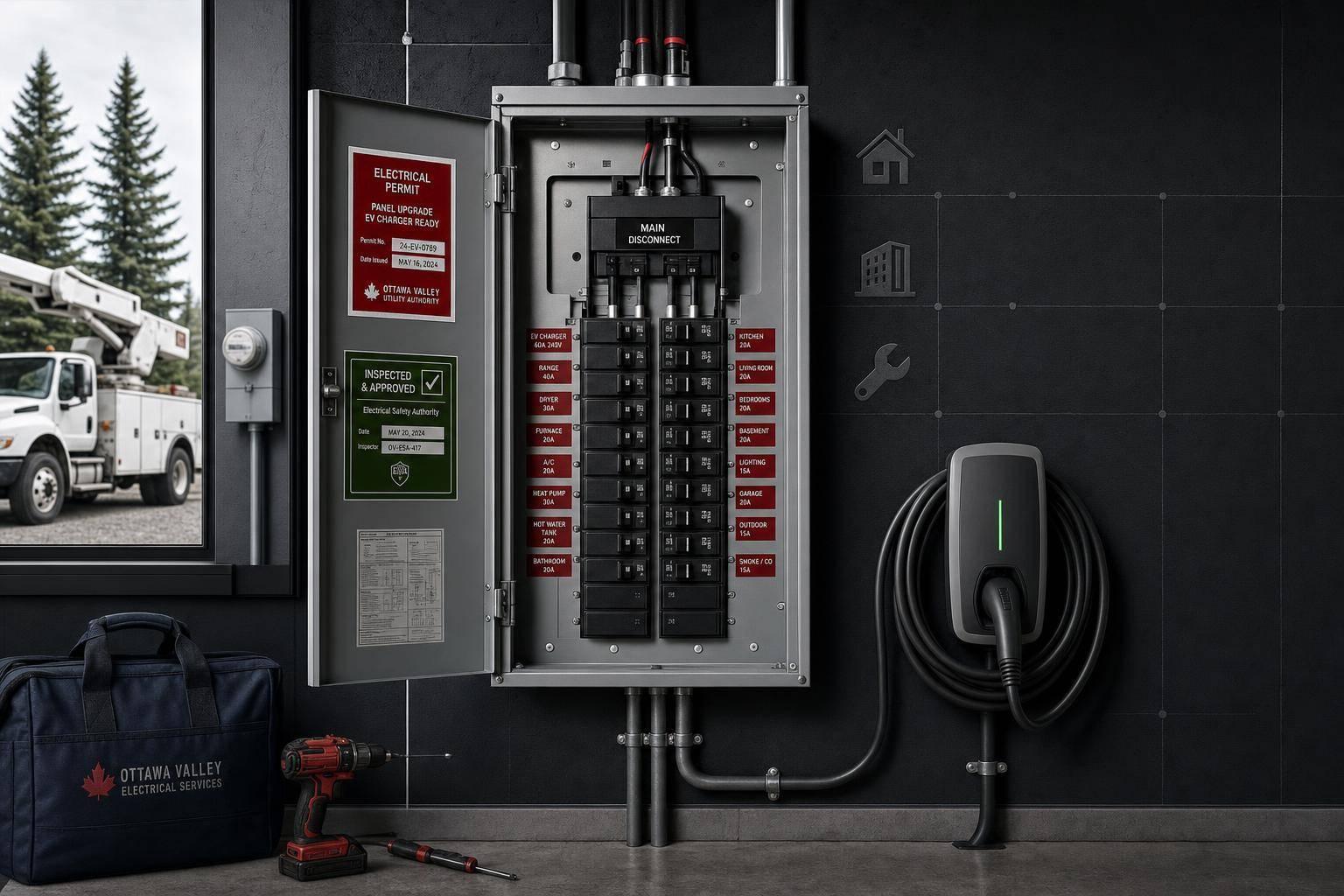
If you want a Level 2 EV charger, your utility can affect the job as much as your panel. In many Ottawa Valley homes, a charger on a 240 V, 40–60 A circuit can push an older 100 A service past its limit, which is why many installs end up moving to 200 A service.
Here’s the short version:
The main utilities covered are:
What changes from one utility to another? Mostly the paperwork, approval timing, and whether the utility has to review service, meter, line, or transformer capacity. Urban jobs are often simpler. Rural jobs can involve more checks, especially where local capacity is tight.
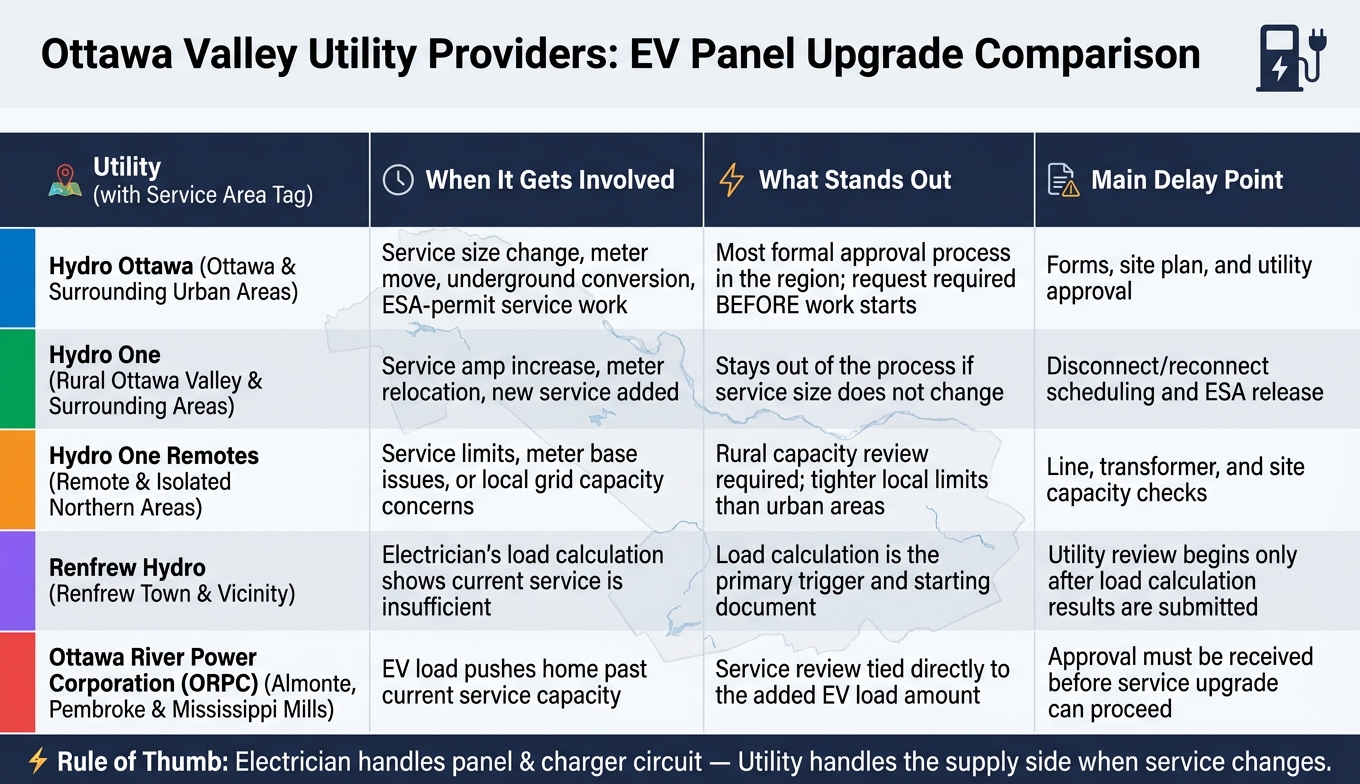
Ottawa Valley Utility Providers: EV Panel Upgrade Comparison Guide
| Utility | When it gets involved | What stands out | Main delay point |
|---|---|---|---|
| Hydro Ottawa | Service size change, meter move, underground conversion, ESA-permit service work | Formal request process before work starts | Forms, site plan, utility approval |
| Hydro One | Service amp increase, meter move, new service | Often stays out if service size does not change | Disconnect/reconnect and ESA release |
| Hydro One Remotes | Service limits, meter base issues, local grid limits | Rural capacity review | Line, transformer, and site checks |
| Renfrew Hydro | When load calculation shows current service is not enough | Starts with electrician’s load review | Utility review after load results |
| ORPC | When EV load pushes home past current service capacity | Service review tied to added load | Approval before service upgrade moves ahead |
A simple rule helps: the electrician handles the panel and charger circuit; the utility handles the supply side when service changes. That’s the frame I’d use before booking any EV work.
Hydro Ottawa requires a service request before any service or panel upgrade starts. Compared with other Ottawa Valley utilities, its approval process is one of the most formal in the region.
Hydro Ottawa treats the following changes as service upgrades:
In many older homes, a 60-amp or 100-amp service won’t be enough once a Level 2 charger is added. In those cases, a move to 200-amp service is often needed.
Once the trigger is confirmed, a licensed electrical contractor submits an Electrical Service Request through Hydro Ottawa’s portal under "Existing residential customer or energy account customer."
The submission must include:
Hydro Ottawa handles the utility side of the service, including the supply conductors, transformer, and revenue meter.
The electrician takes care of the customer-owned equipment and wiring, including the panel, feeder, breaker, grounding, and EV charger circuit.
Hydro Ottawa will not energize the service until ESA approval is confirmed. That makes Hydro Ottawa a clear benchmark when comparing other valley utilities.
Hydro One gets involved only when the job affects the incoming electrical service. So if an EV charger install needs a service-size change or a meter relocation, Hydro One steps in. If you’re only doing EV pre-wiring, Hydro One matters only when the panel upgrade also changes the service.
Here’s the simple version: the electrician handles the panel and the EV circuit. Hydro One comes in when the home’s service has to be upgraded.
Hydro One needs a service upgrade request when a homeowner wants to:
If the current service can handle the extra load, Hydro One doesn’t need to be involved.
Hydro One usually enters the picture only when the service itself has to change. That makes this a bit different from setups that ask for formal pre-approval earlier in the process.
A licensed electrician checks the load first and then submits the service upgrade request to Hydro One. Hydro One temporarily disconnects power at the meter so the work can be done. After that, power is restored once ESA releases the installation.
For a residential upgrade, Hydro One will usually ask for:
Once Hydro One approves the request, it confirms that the local system can supply the requested service size. After the work is done, ESA must inspect the installation and issue a release before Hydro One restores power.
Hydro One Remotes serves rural and remote properties in the Ottawa Valley, where adding EV charging can set off a service review. The path is the same as with Hydro One, but remote areas often run into tighter capacity limits.
Hydro One Remotes gets involved when the current service, meter base, or local distribution capacity can’t handle the added EV load. In remote service areas, the utility also reviews the job when local capacity or equipment limits stand in the way of the upgrade. In plain terms, that review is part of the upgrade itself, not just paperwork.
Hydro One Remotes checks line and transformer capacity, then confirms whether the upgraded service can be connected safely.
Renfrew Hydro takes a local approach to residential upgrades. The review is based on service capacity and the electrician’s load calculation.
A panel upgrade is needed when the electrician’s load calculation shows the current panel can’t support the EV charger along with the rest of the home’s electrical load.
The main document Renfrew Hydro looks at is the electrician’s load calculation. Once that calculation confirms that a service capacity change is needed, the utility reviews the service request.
Put simply, the electrician’s load calculation is the starting point for the utility review.
Ottawa River Power Corporation (ORPC) steps in when an EV charger pushes a property past its current service capacity and a larger utility service is needed.
That usually happens when the electrician’s load calculation shows the existing service can’t carry the added EV load. At that point, ORPC reviews the service request before any service upgrade moves ahead.
The next section looks at how that review process changes from one local utility to another.
The main differences come down to approvals, paperwork, and timing. In some cases, the utility also has to check whether the service can handle the added demand. So while the panel work may look similar from one job to the next, the path to approval can feel quite different depending on the utility.
A licensed electrician usually starts with a load calculation. That step shows whether the current electrical service can support the added load. From there, the contractor follows the utility’s request process and permit steps before the utility review begins.
It sounds simple on paper. In practice, this is where jobs can slow down if forms are missing or the utility wants extra details.
The process usually starts with the contractor’s assessment, then moves into permitting and service upgrade coordination. After the work is done, the required inspection follows.
If utility involvement is needed, it’s best to confirm that at the start. That helps avoid a frustrating situation where the installation is ready, but the project can’t move ahead because a utility approval is still missing. Licensed electricians manage the load assessment, panel upgrade, EV charger installation, and utility coordination, so their role shapes how fast the job moves from review to installation.
Urban utilities often move faster because service runs are shorter and access is easier. There are simply fewer moving parts.
Rural utilities, including Hydro One Remotes and similar service areas, often need extra review before approval. That can include checks related to:
That extra coordination can stretch the timeline, even when the electrical work at the home itself is fairly straightforward.
The most useful way to compare utilities is by looking at how each one affects the timeline, not the panel upgrade itself. Hydro Ottawa tends to be the most formal. Hydro One is usually the simplest when the service stays unchanged. Rural utilities often involve the most back-and-forth because they may need added review beyond the home.
That’s why early contact with the utility matters before EV pre-wiring and panel work begin.
Not every utility in the Ottawa Valley deals with panel upgrade requests the same way. The paperwork and service rules can change from one utility to the next, and that can affect the timeline even when the electrical work inside the home is pretty simple. That’s why the serving utility matters just as much as the panel itself.
Start with a load calculation before you buy any equipment. It shows whether your current service – usually 100 A or 200 A – can handle EV charging or if you need a panel or service upgrade.
Permits and ESA releases help keep the utility work and the home-side work in sync.
A licensed electrician can handle the permits, ESA release, and utility coordination. For Ottawa Valley EV projects, Draper Electric handles panel upgrades, EV charger installations, and utility coordination.
Confirm your utility, complete the load calculation, and coordinate with a licensed electrician and the ESA before booking installation work. That order helps keep the project moving and cuts down on the most common causes of delay.
It depends on your home’s current electrical capacity and how much power you’re already using. A Level 2 charger usually needs its own 40 A or 50 A dedicated circuit.
Many newer homes come with 200 A panels. Older homes with 100 A service may not have enough room for that extra load. A licensed electrician from Draper Electric can run a load calculation to check whether your current setup can handle it or if you’ll need a 200 A service upgrade.
Ask a licensed electrician. They can check your home’s electrical capacity, run load calculations, and go over local code and permit rules.
They’ll tell you if your current electrical service can handle an EV charger, if your panel needs an upgrade, and if you need approval or permits from your utility or local electrical authority.
The biggest delays usually happen during planning and permits. Another common holdup is fixing electrical issues that were already there before the project started.
Before any work begins, a licensed electrician needs to assess the home, complete load calculations, and confirm that everything meets code. If the home has outdated wiring, limited service capacity, or improper grounding, that can stretch the timeline too.