Electrical Products & Services
Smart Level 2 charging offers the best balance of cost, speed and grid impact for Canadian homes.
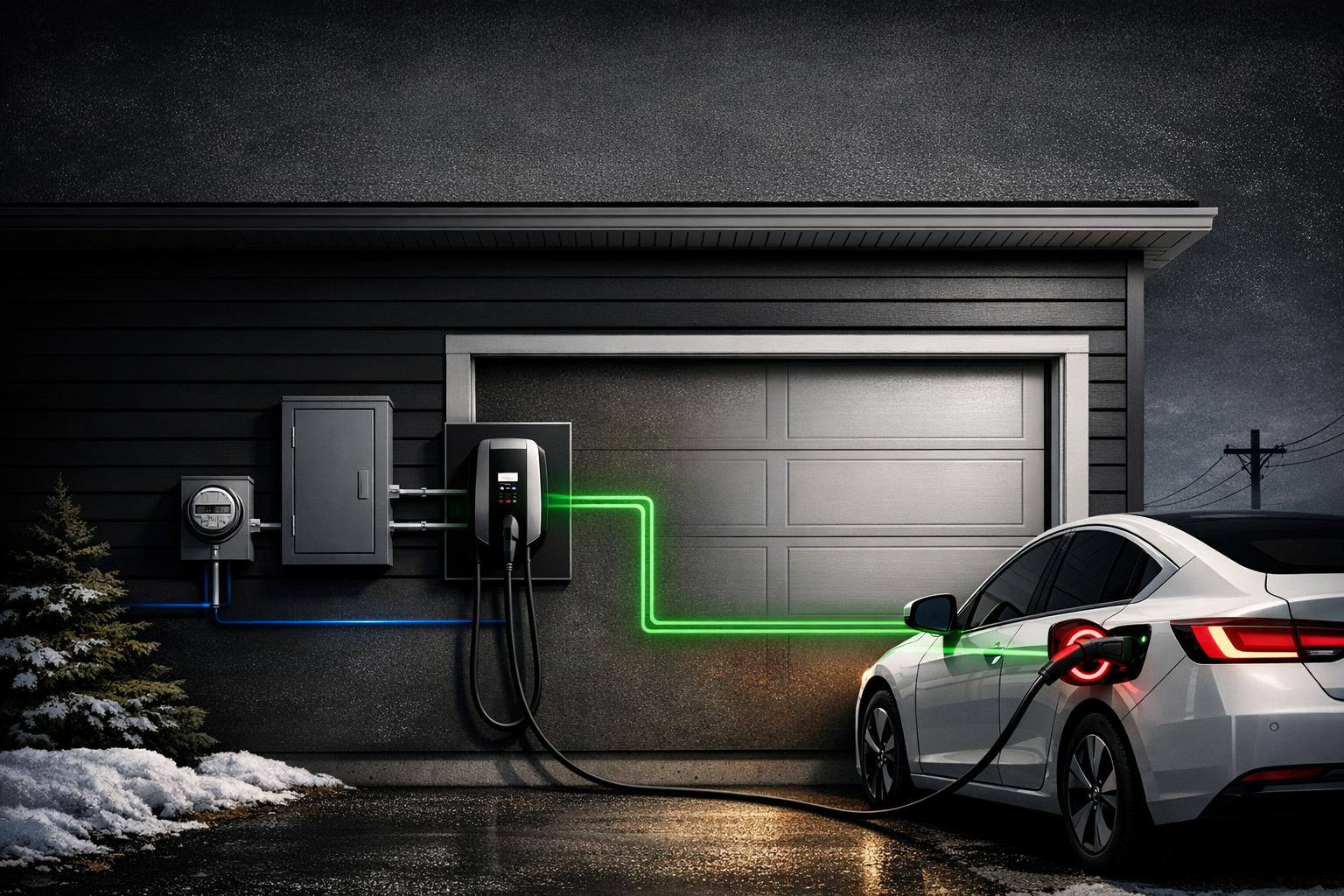
EV home charging is transforming energy use in Canada. With 90% of EV owners charging at home, the demand on electrical systems is growing fast. By 2040, EVs will increase grid demand by 22,500 MW, and many older homes may struggle to support Level 2 chargers due to outdated panels. Here’s what you need to know about the three main charging options:
| Feature | Standard Level 1 | Standard Level 2 | Smart Level 2 | Solar + Storage |
|---|---|---|---|---|
| Upfront Cost | $0 | $1,500–$3,500 | $1,800–$4,000 | $30,500–$48,000 |
| Annual Energy Cost | Grid rates | Grid rates | $150–$400 | $0–$100 |
| Grid Dependency | High | High | Moderate | Low |
| Outage Resilience | None | None | None | High (12–48+ hrs) |
Smart Level 2 chargers are the best balance for most Canadians, offering faster charging, cost savings, and compatibility with older panels. For energy independence, solar-integrated systems are ideal but require a larger investment. Always hire a licensed electrician to ensure your setup is safe and compliant.
Charging your EV at home typically involves either a Level 1 (120V outlet) or Level 2 (240V dedicated circuit) setup. Level 1 chargers add about 6–8 km of range per hour, which is fine for plug-in hybrids or drivers with short daily commutes. However, for most full EV owners, a Level 2 charger is far more practical, delivering 30–50 km of range per hour. This means a full overnight charge is usually more than enough for daily use.
Installing a Level 2 charger in Ontario typically costs between $1,500 and $2,800, which includes the 240V circuit, an ESA permit, and professional labour. However, if your setup is more complex – say, running wiring to a detached garage – costs can climb to $3,000 or more. Standard chargers don’t include adaptive load control, so if your electrical panel needs upgrading to handle the extra load, expect to pay an additional $4,500 to $7,500.
"A standard Level 2 EV charger installation in Ontario typically costs between $1,500 and $2,800. This price includes a dedicated 240V circuit, the mandatory ESA permit fee, and professional labour." – Toronto EV Experts
Charging at home is still much cheaper than fuelling a gas car. On average, it costs less than $2 per 100 km, compared to $8–$12 per 100 km for gasoline. By charging overnight between 11 p.m. and 7 a.m., you can take advantage of Ontario’s off-peak electricity rates. If you’re on the Ultra-Low Overnight (ULO) plan, rates can drop as low as 2.8 cents/kWh.
Using a Level 2 charger increases your household’s electricity draw significantly – from a typical base load of 1.5 kW to around 7.7–9.6 kW during charging. For the average Canadian driver covering 16,000 km annually, this adds 2,500 to 3,500 kWh to your yearly electricity consumption. At current rates, that’s about $400 to $700 per year. Keep in mind that winter conditions can increase energy use by 30–50% due to the extra power needed for battery and cabin heating.
Standard chargers pull electricity directly from the grid without any built-in demand management. This can put additional strain on the system, especially during peak hours. Under the Canadian Electrical Code, EV charging is considered a continuous load, meaning the circuit must be rated at 125% of the charger’s amperage. For example, a 40A charger requires a 50A breaker.
During power outages, grid-tied chargers automatically shut down due to anti-islanding protection, which ensures no power flows back to the grid for safety reasons. Without a backup battery or a vehicle capable of bidirectional charging, your EV will remain uncharged until power is restored.
Smart EV chargers take things a step further than standard options, offering dynamic control to manage energy use more efficiently and potentially avoid costly upgrades to your electrical system. These Level 2 chargers come equipped with Wi‑Fi, allowing you to schedule charging sessions and monitor energy consumption in real time. Unlike standard chargers that immediately draw power, smart chargers adjust to your home’s energy demands, aligning with the push for grid-friendly and efficient EV solutions.
Investing in a smart charger (ranging from $600 to $1,200) combined with an Electric Vehicle Energy Management System (EVEMS) ($200–$400) can help you avoid service upgrades that typically cost between $2,000 and $5,000. For example, an EVEMS like the DCC‑9 automatically adjusts the power draw based on your home’s available capacity, eliminating the need for expensive electrical upgrades.
Pairing a smart charger with Ontario’s Ultra‑Low Overnight (ULO) plan can further cut costs. With electricity rates as low as 3.9 cents/kWh during off-peak hours (11 p.m. to 7 a.m.), you could save $300 to $400 annually on charging your EV.
Smart chargers give you a clearer picture of your energy consumption compared to standard options. Through a companion app, you can monitor real-time energy use, review historical data, and even set charging limits. For instance, setting daily charging to 80–90% can help maintain your battery’s long-term health. In colder months, the app can pre-condition your vehicle’s cabin and battery while it’s still plugged in, preserving your driving range without draining the battery after you hit the road.
An EVEMS plays a key role in managing your home’s total energy load by reducing charging speeds when high-demand appliances are in use, ensuring your system stays within safe limits. On a larger scale, smart charging platforms powered by AI have shown impressive results. For example, they’ve reduced peak transformer loads by 31.5% and narrowed voltage fluctuations from ±5.8% to ±2.3% on local grids. In Q3 2024, BluWave‑ai and Hydro Ottawa successfully conducted Canada’s first AI-driven demand response events using the EV Everywhere platform. During these events, 13.73% of enrolled EV owners allowed their charging sessions to pause automatically during peak grid stress.
"By enabling large numbers of electric vehicles to respond dynamically to grid conditions, we create virtual storage capacity that enhances grid flexibility and supports the integration of distributed energy resources." – Guillaume Paradis, Chief Operating Officer, Hydro Ottawa Holding Inc.
While a smart charger shuts down during a power outage, pairing it with a battery or a bidirectional-capable EV can increase your home’s resilience. Additionally, smart EVEMS systems can be configured to reduce EV charging when a standby generator is running, preventing the generator from overloading. For residents in the Ottawa Valley, a reliable provider like Draper Electric (https://draperelectric.ca) can help ensure your EV charging setup is safe and meets local standards. These features pave the way for even more advanced solutions, which will be covered in the next section on solar-integrated charging.
Building on the benefits of smart charging, integrating solar power takes things a step further by using renewable energy to reduce reliance on the grid. With solar-integrated EV charging, you can generate your own electricity and store any excess for later. This means your car can charge using stored solar energy, even after the sun goes down. While the upfront costs can be higher, these systems can lead to long-term savings and greater energy independence.
"The traditional solar model – generate during the day, export excess to the grid, import at night – is becoming obsolete." – SolarCalculatorCanada.org
Installing a 3 kW solar array with battery storage and a Level 2 smart charger typically costs between $20,000 and $25,000 before applying any incentives. Federal and provincial programs can significantly reduce these costs. Over a 25-year period, solar-generated electricity can cost as little as $0.02–$0.04 per kWh, compared to the $0.10–$0.20 per kWh charged by the grid. EV households using solar power can lower their annual energy costs to as little as $0–$400, a stark contrast to the $3,900–$6,000 spent annually on fuelling a gas-powered vehicle.
These systems make it possible to charge your EV using only the energy produced by your solar panels. Smart chargers equipped with "solar-matching" modes can automatically adjust charging speeds to match the amount of solar energy being generated in real time, ensuring minimal reliance on grid power.
In Canadian winters, bifacial solar panels, which capture light reflected off snow, can increase energy output by up to 30%. To meet an EV’s typical annual energy consumption of 3,000–4,000 kWh, adding 6–8 extra 400W panels (about 2.4–3.2 kW more capacity) is a practical approach.
Adding a home battery system changes how you interact with the grid. By using stored solar energy during peak hours – like Ontario’s 4:00 p.m. to 9:00 p.m. window, when electricity rates can hit 39.1¢/kWh – you can avoid expensive charges. In Ontario, this strategy can create a rate difference of about 35.2¢/kWh between overnight ultra-low rates and peak prices, offering a clear financial advantage. Additionally, AI-driven solar-matched charging improves solar usage efficiency, increasing it from 48% to 66%, while reducing peak transformer loads by 31.5%.
Solar-plus-storage systems provide a significant edge during power outages. A 13.5 kWh battery system can keep essential appliances running for 10–27 hours, depending on usage. Additionally, emerging Vehicle-to-Home technology could allow your EV to act as an extra battery during longer outages. This feature is particularly useful in areas like the Ottawa Valley, where ice storms and winter outages are common. For installations involving solar panels, battery storage, and EV chargers, working with qualified professionals like Draper Electric ensures everything is safely and correctly installed.
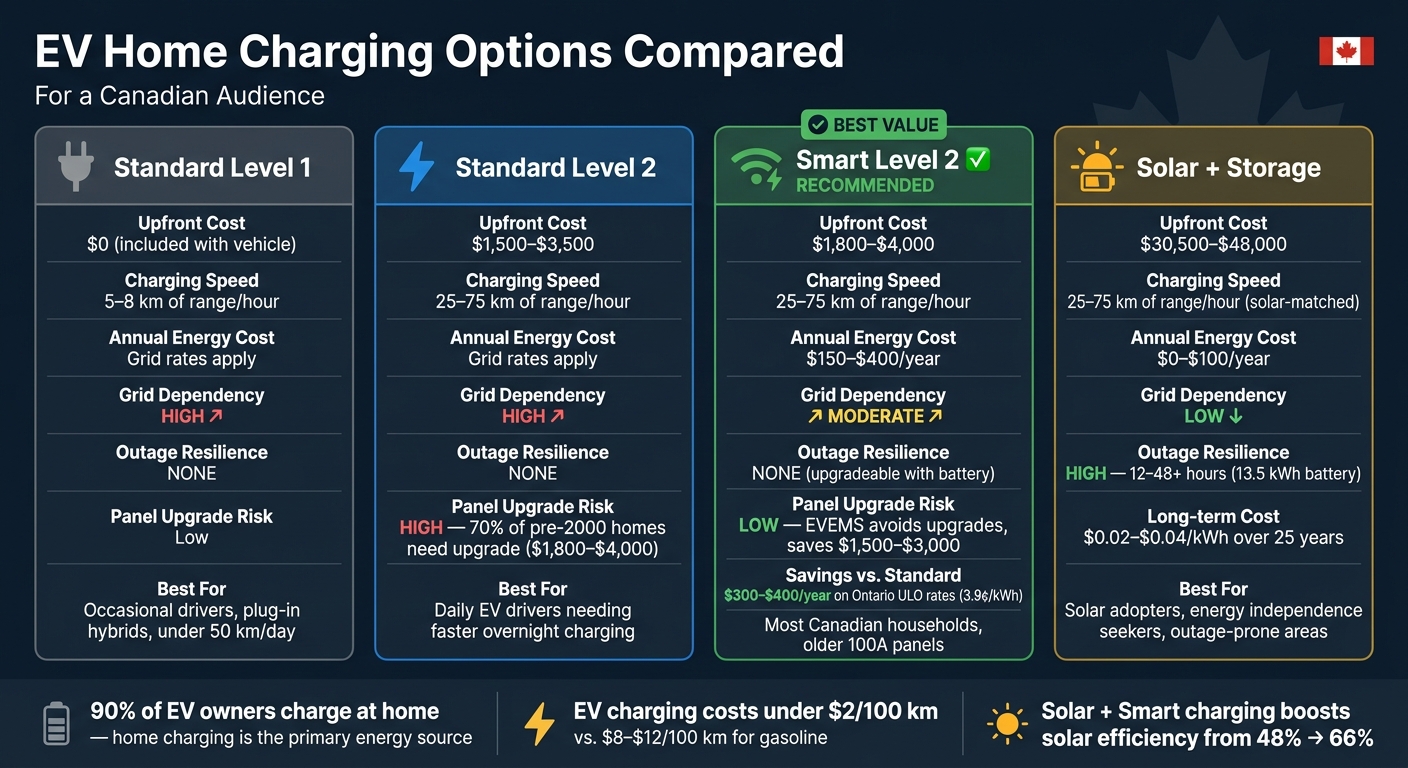
EV Home Charging Options Compared: Cost, Efficiency & Resilience
When it comes to charging solutions, every option has its own set of trade-offs. Your choice will depend on factors like your budget, your home’s electrical capacity, and how much you’re looking to save on energy costs over time. To make things clearer, here’s a breakdown of the available options and their key differences.
Standard Level 1 charging is the most basic option, with no extra upfront cost since the charging cord is usually included with the vehicle. However, it’s slow – adding just 5–8 km of range per hour. While this might work for occasional drivers, it’s less practical in harsh Ottawa Valley winters. When temperatures drop to −20°C or even −30°C, your vehicle’s range can shrink by 20–40%, making Level 1 charging insufficient for daily commutes.
Standard Level 2 charging offers a significant speed increase, delivering 25–75 km of range per hour. But this comes at a cost. It can draw up to 9.6 kW of power continuously, which might push older homes with 100A panels beyond their limits. If your home was built before 2000, there’s a 70% chance you’ll need to upgrade your panel, which could cost anywhere from $1,800 to $4,000.
Smart Level 2 charging solves many of these issues. With features like automatic scheduling, you can take advantage of Ontario’s Ultra-Low Overnight rates (3.9¢/kWh), cutting annual charging costs to $150–$400 compared to $500–$900 on standard rates. Built-in load management, or EVEMS, can also save you from expensive panel upgrades, potentially reducing costs by $1,500–$3,000. The downside? These chargers cost $200–$400 more upfront than basic Level 2 units and require a reliable Wi-Fi connection.
Solar-integrated charging with storage stands out for its long-term savings and ability to keep you powered during outages. While it’s the most expensive option to install – ranging from $30,500 to $48,000 – it offers unmatched resilience and independence from grid fluctuations. This solution is ideal for those looking to invest in energy self-sufficiency.
Here’s a quick comparison of the four options to help you decide:
| Feature | Standard Level 1 | Standard Level 2 | Smart Level 2 | Solar + Storage |
|---|---|---|---|---|
| Upfront Cost | $0 (included) | $1,500–$3,500 | $1,800–$4,000 | $30,500–$48,000 |
| Annual Energy Cost | Grid rates apply | Grid rates apply | $150–$400 | $0–$100 |
| Grid Dependency | High | High | Moderate | Low |
| Impact | Low (slow draw) | High (peak demand) | Low (load balanced) | Positive (offsets peak) |
| Outage Resilience | None | None | None | High (12–48+ hours) |
"Smart scheduling and energy monitoring are valuable. Load management pays for itself. Everything else is noise." – ThinkEV.ca
When deciding on a charging option, consider your driving habits, home electrical capacity, and energy preferences. For most Canadian households, Smart Level 2 charging strikes the right balance – it provides quick charging for daily commutes, aligns well with Ontario’s Ultra-Low Overnight rates, and often works with older 100A panels without requiring expensive upgrades. If your daily driving is under 50 km or you own a plug-in hybrid, Level 1 charging might be enough. For those generating solar power or planning to, solar-plus-storage systems offer greater energy independence. Smart charging not only boosts efficiency but also helps ease grid demand, promoting a greener future for EV users. Whatever option you choose, proper installation following local regulations is essential.
For anything beyond Level 1, professional installation is non-negotiable. Any 240V circuit requires an ESA permit, inspection, and a licensed contractor. Skipping these steps could void your home insurance in case of an issue.
Draper Electric, a trusted name in the Ottawa Valley since 1993, is led by Master Electrician Randy Draper, who brings over 30 years of experience. Fully licensed with ESA, Draper Electric conducts CEC 8-200 load calculations to assess whether your current panel can handle the extra demand or if an upgrade is necessary. With their expertise, you can be confident your charging solution meets all safety standards.
Getting your EV charger installed correctly from the start not only avoids costly repairs down the line but also ensures safety and compliance. Have a licensed electrician evaluate your home before adding a Level 2 or solar-integrated charging system.
Upgrading your electrical panel isn’t always necessary. According to the Canadian Electrical Code (CEC), it depends on a load calculation that considers your current appliances and your panel’s service capacity. If your panel doesn’t have enough capacity, there are alternatives like Electric Vehicle Energy Management Systems (EVEMS) or load-sharing devices that can help manage the load. Generally, you’ll only need an upgrade if your panel is full, outdated, poses a safety risk, or if you’re planning to add significant electrical loads like a heat pump or a hot tub.
An Electric Vehicle Energy Management System (EVEMS) helps prevent breaker trips by keeping an eye on your home’s real-time electrical usage. When your energy demand approaches a set limit – say, 80% of your panel’s capacity – the system automatically reduces or temporarily stops power to your EV charger. This ensures your electrical system stays within safe operating limits, even when high-power appliances are running. Draper Electric provides professional installation to seamlessly integrate this smart solution into your home.
For those living in Ottawa, a solar and battery system can be a great option for winter EV charging, though it’s not a necessity. Solar production does decrease during the shorter days of winter, but net metering makes it possible to use the credits earned during sunnier summer months to balance out winter energy expenses. By including a battery in your system, you can store solar energy generated during the day for use in the evening, and it also doubles as a backup power source. Draper Electric can evaluate your system to ensure it aligns with your EV charging requirements.