Electrical Products & Services
Compare LED bulb swaps and integrated fixtures; calculate electricity, replacement and installation costs for true 1/5/10‑year payback.
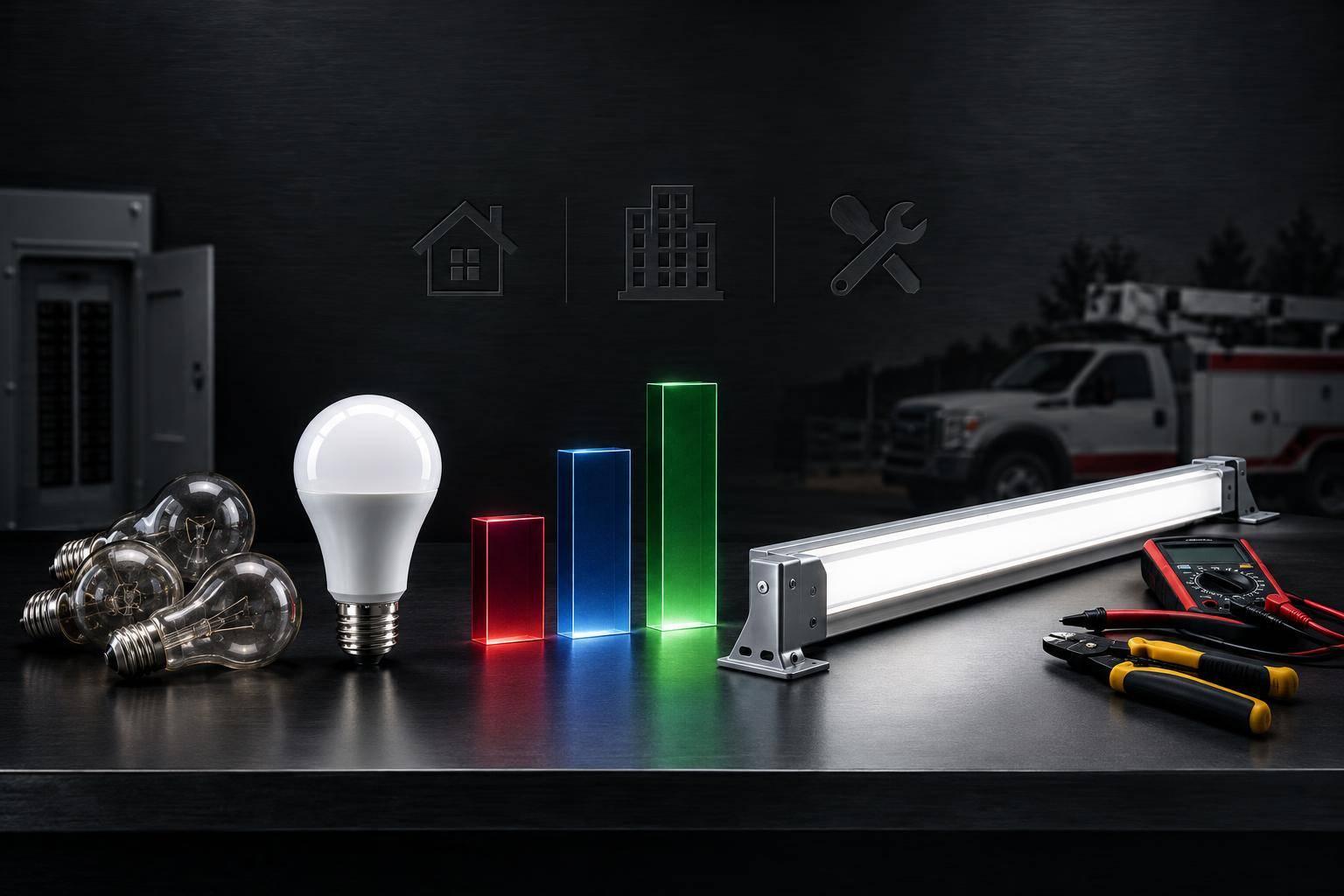
LED replacement bulbs usually offer the lowest-cost upgrade for existing sockets. A $3, 9 W LED replacing a 60 W incandescent uses 85% less electricity and pays back its purchase price in about four months at three hours daily and $0.15/kWh.
The best choice depends on what needs replacing:
Quick Comparison
| Option | Upfront cost | Electricity use | Replacement and labour costs |
|---|---|---|---|
| Existing incandescent | None while it works | Highest | Frequent bulb changes |
| LED replacement bulb | Typically $2–$5 for a basic bulb | About 85% less for 9 W versus 60 W | Usually no installation labour; check rated life |
| Integrated LED fixture | Fixture plus installation | Similar to an equally efficient LED bulb | Check driver access, warranty and replacement costs |
Compare total costs over 1, 5 and 10 years, not just purchase prices. Start with the most-used lights, match lumens for brightness, and use actual electricity rates and installation quotes. Working halogen and CFL bulbs need separate calculations because their energy savings will be smaller.
All amounts are Canadian dollars. Savings depend on hours of use, electricity rates, product life and labour costs.
Use the existing incandescent as your baseline. Count only future electricity, replacement bulbs and any labour needed to reach them. Compare total ownership cost over 1, 5 and 10 years using these costs.
Hours of use determine electricity consumption and how soon a bulb needs replacing.
A standard incandescent lasts about 1,000 hours – about 2.7 years at 1 hour a day, or 11 months at 3 hours a day.
Hard-to-reach bulbs can also add labour or service costs.
In stairwells, high ceilings and exterior fixtures, repeated changes can mean ladder work or paid assistance.
Record access costs separately rather than treating every bulb change as free.
To calculate payback, weigh the LED’s upfront cost against electricity savings and avoided replacements, using the incandescent’s future running costs as the baseline. This gives the next sections a consistent basis for comparing LED replacement bulbs and integrated fixtures.
For most existing sockets, replacement bulbs are the lowest-cost way to switch to LED lighting. You keep the fixture and change only the bulb.
Basic A19 LEDs cost about $2–$5 each in multipacks, before tax. Specialty and dimmable bulbs cost more. Since replacement bulbs use the existing socket, you usually won’t need to pay for professional electrical services.
Before buying, check the base, voltage, and fit. Household fixtures typically use E26 bases and 120 V. To replace a 60 W incandescent, choose about 800 lumens.
Use bulbs rated for enclosed or damp locations where required. Dimmable LEDs also need compatible dimmers to prevent flicker or buzzing.
A 9 W LED uses about 85% less electricity than a 60 W incandescent.
Natural Resources Canada says ENERGY STAR-certified LEDs last at least 15 times longer than incandescents.
Check each bulb’s rated life and warranty. Heat and incompatible fixtures can shorten its service life.
A $3, 9 W LED used for 3 hours daily instead of a 60 W incandescent saves about 55.8 kWh annually. At $0.15/kWh, electricity savings are about $8.40 a year, paying back the bulb price in roughly four months. If the incandescent costs $1 to replace and the LED costs $3, the extra $2 pays back in about three months.
When comparing total ownership costs, include the replacement bulbs you won’t need to buy. This example excludes tax, labour, and fixed electricity charges – only the energy-use portion of the bill goes down.
If the fixture also needs replacing, compare these bulb savings with the cost of an integrated LED fixture.
When a bulb swap won’t solve the problem, compare the cost of replacing the whole fixture. With integrated LEDs, you’re paying for a fixture and installation, not just a new bulb.
Budget for both the fixture and installation by a licensed electrician. Get an itemized Canadian quote that covers mounting, wiring, dimmer compatibility and any work needed to meet code. Older homes may need extra mounting or wiring work.
Integrated LED fixtures can make sense when the existing fixture is obsolete, damaged or incompatible with LED bulbs.
Compare wattage, light output, rated life and warranty coverage. For outdoor or unheated spaces, check the cold-weather rating. Also ask whether the LED driver can be replaced on its own – and when you’d need to replace the entire fixture.
A lower fixture price shortens the payback period, but hours of use, electricity rates and service costs still determine the result. Without wattage and installed price, there’s no reliable payback estimate.
Use those installed costs in the 1-, 5- and 10-year comparisons below.
Match lumens to compare brightness, rather than watts. An LED’s lifespan depends on driver quality, heat, enclosure rating, and how often it’s switched on and off.
Once brightness is matched, compare power draw and annual electricity costs. Use the table below as the baseline for later payback calculations.
Annual electricity cost = watts ÷ 1,000 × daily hours × 365 × electricity rate.
Monthly electricity use = annual kWh ÷ 12.
At 3 hours/day and $0.18/kWh:
Metric 60 W Incandescent 9 W LED Brightness (lumens) ~800 ~800 Wattage 60 W 9 W Daily Use 3 hours 3 hours Electricity Rate $0.18/kWh $0.18/kWh Monthly Electricity Use 5.48 kWh 0.82 kWh Annual Electricity Cost $11.83 $1.77 Savings vs. incandescent – $10.05
LEDs also cut the number of bulb changes and the labour they require. Their longer life reduces replacement work, especially in hard-to-reach fixtures.
Electricity costs are only part of the payback calculation. For each fixture type, compare installed cost, electricity use, and replacement intervals, including installation labour.
Longer operating hours and higher electricity rates shorten the payback period. Higher installation costs lengthen it. Fewer bulb changes – and less labour spent replacing them – can shorten it further.
For outdoor and security lighting, choose LEDs rated for cold-weather performance.
Hypothetical budget, not a quote. This example uses a $0.15/kWh electricity rate and a 30-day month. All amounts are CAD, before tax. Assume $5 LEDs, no labour for bulb swaps, 60 W incandescents replaced by 9 W LEDs, and 100 W exterior lamps replaced by 15 W LEDs.
Room Lamps Watts per lamp, old → LED Hours/day Monthly electricity saved (kWh) Monthly savings LED bulbs Integrated fixture cost Kitchen 4 60 → 9 6 36.72 $5.51 $20.00 $320.00 Living room 5 60 → 9 5 38.25 $5.74 $25.00 $400.00 Hallway 2 60 → 9 3 9.18 $1.38 $10.00 $160.00 Bathroom 3 60 → 9 2 9.18 $1.38 $15.00 $240.00 Exterior entry 2 100 → 15 10 51.00 $7.65 $10.00 $160.00 Under the same assumptions, total electricity saved is 171.87 kWh/month, worth $25.79/month; the integrated fixture option costs about $1,760 total, including roughly $80 per fixture for labour.
Before setting your budget, ask the electrician to confirm the fixture count and wiring work. The room-by-room savings feed into the 1-, 5- and 10-year ownership costs below.
Assume existing incandescent bulbs each have 1,000 hours remaining; replacement incandescent bulbs cost $1.50 and last 1,000 hours. LED bulbs last 20,000 hours; integrated fixtures last 50,000 hours. Assume constant prices and no discounting.
Here’s how the total costs compare over time, including replacement bulbs.
Option Year 1 Cost Year 5 Cost Year 10 Cost 10-Year Net Savings Retained incandescent $425.00 $2,125.00 $4,250.00 $0.00 (baseline) LED bulb upgrade $225.00 $685.00 $1,260.00 $2,990.00 Integrated fixtures $1,875.00 $2,335.00 $2,910.00 $1,340.00 Net savings are against retained incandescent lights.
Using the same whole-home assumptions, the LED-bulb option saves $309.48 a year in electricity.
Upgrade Upfront incremental cost Annual electricity savings Energy-only payback Break-even including replacements LED bulbs $110.00 $309.48 4.3 months About 4 months Integrated fixtures $1,760.00 $309.48 5.7 years About 5 years
Integrated fixtures take longer to pay for themselves because they cost more upfront, even though the energy savings are similar. The next section looks at how electricity rates, daily use and labour costs change the payback period.
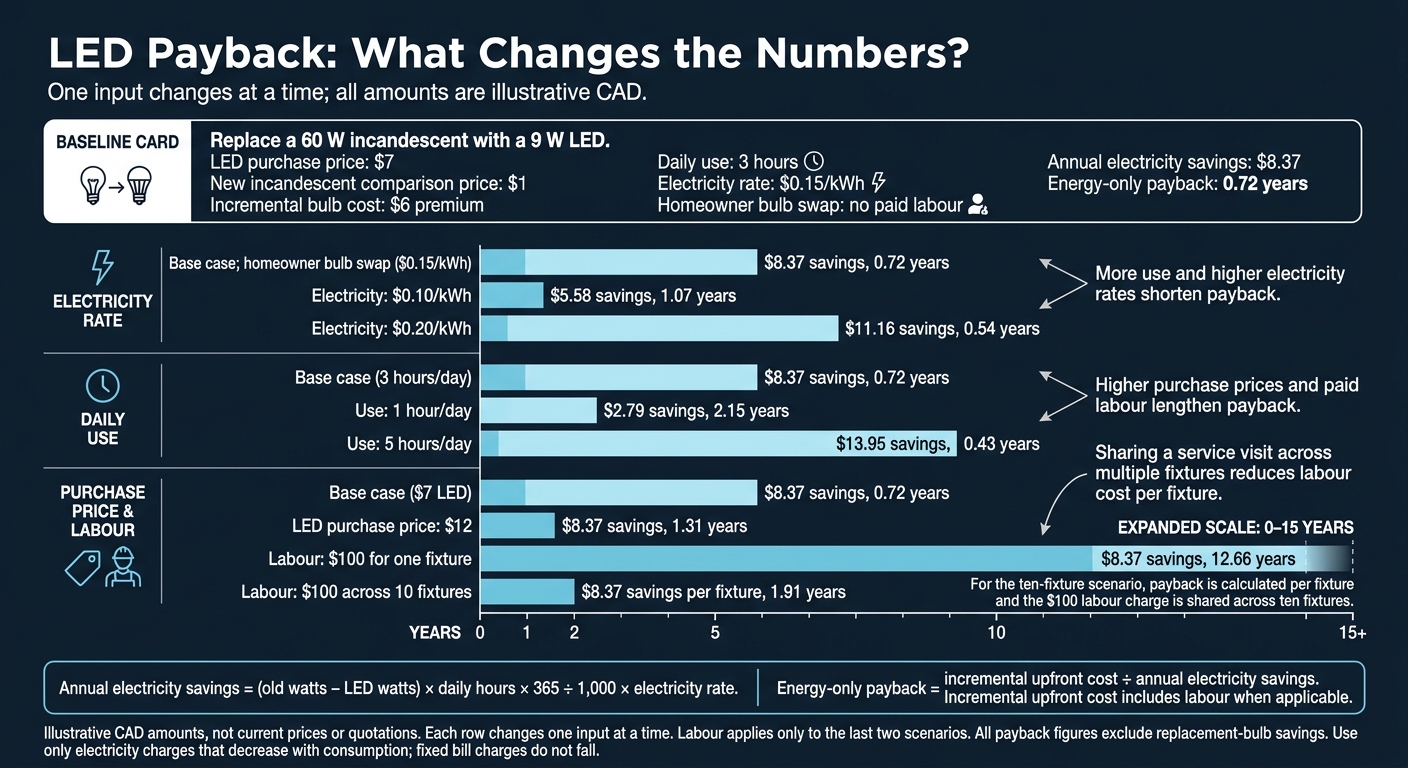
LED Payback: How Electricity Rates, Usage and Labour Change Savings
Electricity rates, daily use, bulb price, and labour costs all affect payback. The comparison below shows what happens when you change one input at a time.
This separate bulb-replacement comparison uses a $7 LED instead of a $1 incandescent – a $6 premium – at three hours daily and $0.15/kWh. Amounts are illustrative CAD, not current prices or quotations. Each row changes one input at a time; replacement savings stay excluded.
Change from base case Annual electricity savings Payback Base case; homeowner bulb swap $8.37 0.72 years Electricity: $0.10/kWh $5.58 1.07 years Electricity: $0.20/kWh $11.16 0.54 years Use: 1 hour/day $2.79 2.15 years Use: 5 hours/day $13.95 0.43 years LED purchase price: $12 $8.37 1.31 years Labour: $100 for one fixture $8.37 12.66 years Labour: $100 across 10 fixtures $8.37 per fixture 1.91 years Labour applies only to the last two rows. Labour-inclusive figures still exclude replacement savings.
Annual electricity savings = (old watts − LED watts) × daily hours × 365 ÷ 1,000 × electricity rate.
Use only the variable charges on your bill that fall when you use less electricity. Labour adds to the upfront cost, stretching payback even when electricity savings stay the same. Get a separate quote for wiring, dimmer, or ceiling-box work. Leave out rebates and HVAC effects unless you verify them separately.
If your existing bulb still works, the calculation changes.
For a working bulb, compare against its remaining life. Electricity savings must recover the LED’s full purchase price, rather than just the price difference between two new bulbs.
All lamps below provide approximately 800 lumens and operate three hours daily at $0.15/kWh. The LED costs $7 and is assumed to last 25,000 hours. Baseline prices are modelling assumptions, not retail quotations; each working bulb starts with its full stated life remaining.
Working baseline Assumed replacement price / life Annual electricity savings with 9 W LED Energy-only payback 60 W incandescent $1.50 / 1,000 hours $8.37 0.84 years 43 W halogen $3 / 4,000 hours $5.58 1.25 years 14 W CFL $4 / 8,000 hours $0.82 8.52 years
Replacement-inclusive break-even also counts future bulb purchases, without labour or discounting. These replacement savings matter most when the existing lamp has a short life or costs more to replace.
Match the lighting option to the room and fixture conditions.
| Option | Payback advantages | Drawbacks and checks |
|---|---|---|
| Retained incandescent | No immediate spending | High electricity use; frequent replacements |
| Retained halogen | No immediate spending | Relatively high electricity use |
| Retained CFL | Already uses much less electricity than incandescent | Small electricity savings from upgrading; check dimmer compatibility |
| LED replacement bulb | Low upfront cost; individually replaceable | Check socket fit, dimmer compatibility and enclosure rating |
| Integrated LED fixture | Suits renovations or failed-fixture replacement | Higher upfront cost; check driver replacement and fixture access |
Look beyond lifespan. Before ordering, check lumen output, colour temperature, outdoor or damp-location ratings, and access for replacement. Match your choice to the fixture and expected use.
Integrated fixtures use no less electricity than equally efficient LED bulbs. Their appeal comes from fit, appearance, or replacing a fixture that already needs work.
Use the costs above to plan upgrades room by room. Start with the lights you use most. LED replacement bulbs keep upfront costs low. Integrated fixtures cost more but can make sense when the existing fixture also needs replacing.
Compare 1-, 5-, and 10-year ownership costs, rather than purchase prices alone. Include electricity, replacement bulbs and installation. Fewer bulb changes make a bigger difference when lights are hard to reach.
Assess low-use rooms separately. For exterior lights, use the actual hours set by timers or recorded through sensor use. Base your decisions on your household electricity bill, purchase prices, expected hours of use and installation quotes to see which upgrades are worth doing now.
Hire a licensed electrician for wiring work, hardwired fixtures or help checking dimmer compatibility. Draper Electric serves residential, commercial and renovation projects in the Ottawa Valley.
Yes, LED upgrades can still be worth it if you’re moving soon. Swapping bulbs is a simple, low-cost way to improve lighting quality and energy efficiency using your existing fixtures – without paying for a full renovation. You’ll start saving energy right away, and the improved lighting may make your home more appealing to potential buyers.
Replacing dimmers adds to your upfront costs, so it takes longer for energy and maintenance savings to pay for your LED upgrade. Older dimmers can cause LEDs to flicker, buzz, or dim unevenly. Include compatible replacement controls in your payback calculation.
For complex projects that involve dimmer updates, hire a licensed electrician to check compatibility and ensure the installation meets code.
LED lighting is designed to last 50,000 to 100,000 hours, but some products can fail sooner. Start by checking compatibility with dimmers or sensors. Make sure the products are high-quality and rated for the conditions where they’re installed, including fixtures with suitable IP ratings for wet or dusty areas.
If problems continue, have a licensed electrician inspect the fixture, drivers, and circuits to confirm that the wiring and controls match the LED load.