Electrical Products & Services
Practical steps to diagnose and fix voltage sags, harmonics, surges, and other power quality problems, and when to call an electrician.
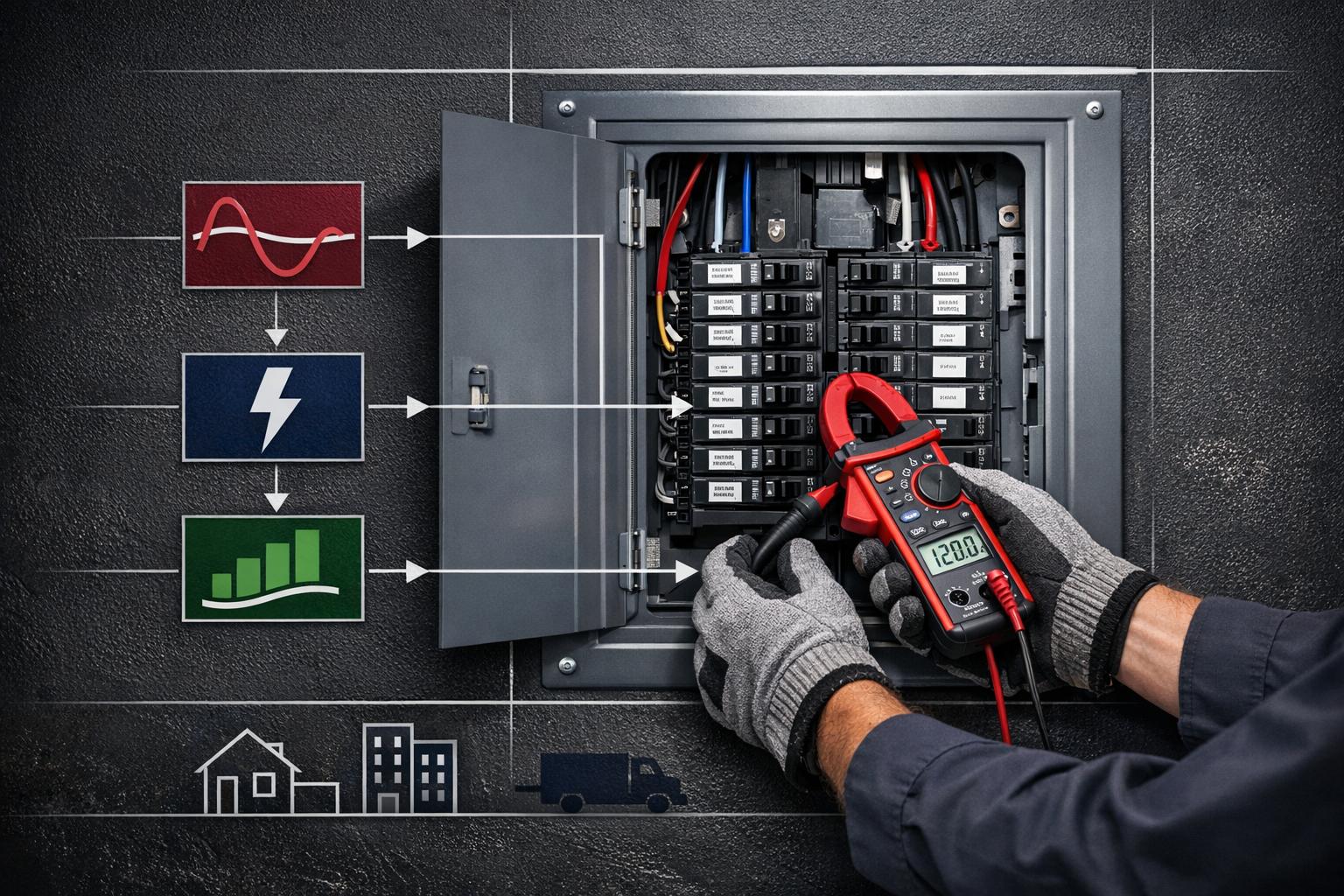
Power quality issues disrupt operations, damage equipment, and increase costs. Here’s what you need to know:
Fixing power quality problems involves identifying the cause, addressing it with tools or professional help, and implementing safeguards like surge protection and routine maintenance to prevent future issues.
Getting ready to troubleshoot power quality issues isn’t just about having the right tools – it’s about prioritizing safety. Skipping safety steps or diving in unprepared can turn a minor problem into something far more dangerous. Start by ensuring safety measures are in place, then gather the tools you’ll need for accurate diagnostics.
The number one rule: never work on a live panel. Always turn off the circuit you’re working on and verify it’s de-energized with a meter before proceeding.
One risk often underestimated is arc flash – a sudden and violent burst of energy that can cause severe injuries. The Electrical Safety Authority emphasizes:
"Only qualified personnel should perform any required testing and maintenance work." – Electrical Safety Authority
At a minimum, you’ll need insulated gloves, safety glasses, and insulated tools rated for the voltage level you’re working with. If you’re unsure about the situation, don’t hesitate – call a professional.
Having the right tools can make all the difference when diagnosing power quality issues. Here are some essentials:
| Tool | Purpose |
|---|---|
| True RMS Multimeter | Provides accurate voltage and current readings, even with distorted waveforms |
| Clamp Meter | Measures current without needing to disconnect the circuit |
| Power Quality Analyzer | Tracks voltage dips, swells, harmonics, and other events over time |
As Fluke explains, "Using a power quality analyzer allows electricians and engineers to view harmonic frequencies individually for each phase, which is crucial for diagnosing power quality issues." Considering that voltage sags account for up to 80% of power quality problems, having an analyzer in your toolkit is invaluable.
While tools can help identify many issues, some situations demand professional expertise.
If you encounter persistent issues – like frequent breaker trips, warm outlets, flickering lights, or visible wiring damage – it’s time to call a licensed electrician. In Ontario, the Electrical Safety Code requires that work on main electrical panels and service equipment be performed by an ESA-licensed electrician.
For those in the Ottawa Valley, Draper Electric has been a trusted provider of licensed electrical troubleshooting and maintenance services since 1993. They have the experience and qualifications to safely address even the most complex power quality concerns.
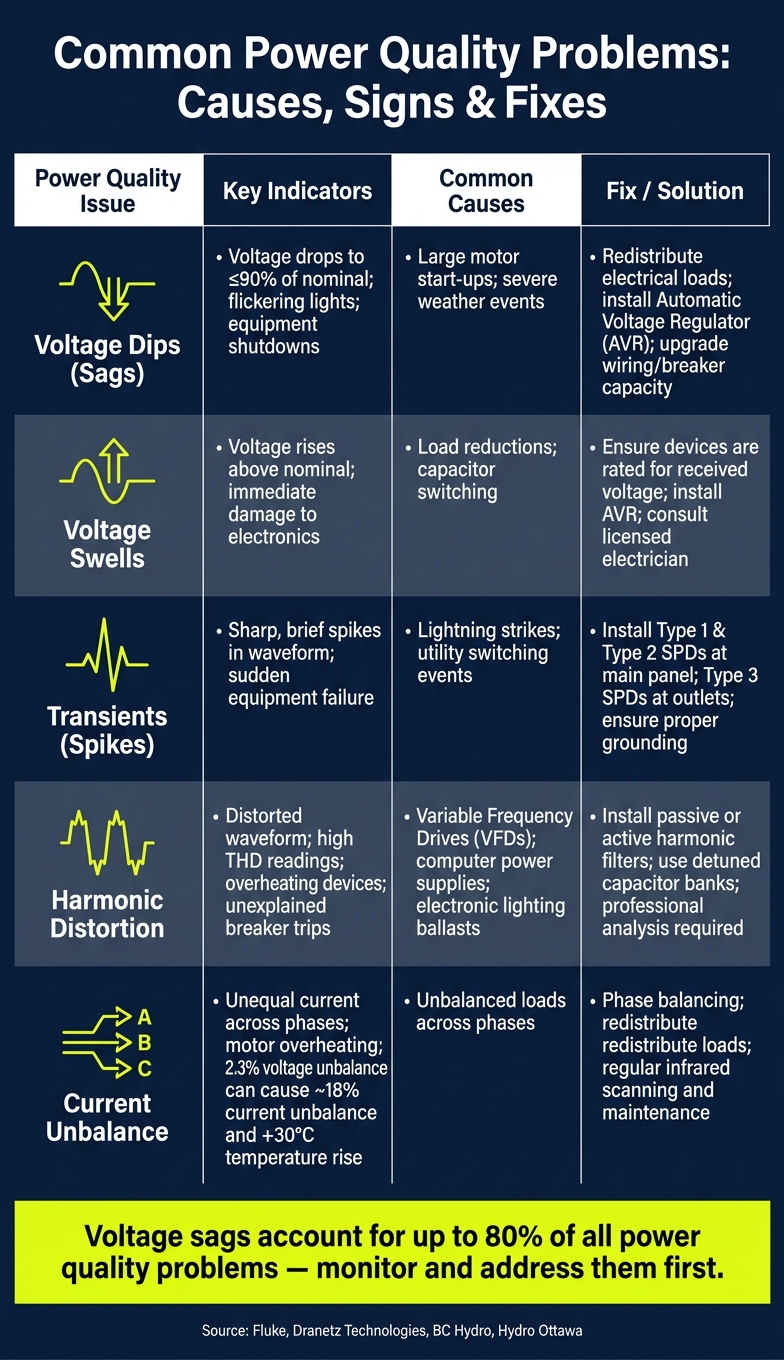
Common Power Quality Problems: Causes, Signs & Fixes
Before diving into diagnostics, ensure safety measures are in place and gather the necessary tools. Once you’re ready, take a structured approach to pinpoint the root cause of the issue.
Start by identifying whether the issue is isolated to a single device, a circuit, or the entire building.
Hydro Ottawa provides a helpful guideline:
"You may be experiencing power quality problems if: Lights flicker or dim frequently, computers or electronics restart or shut off on their own, circuit breakers trip for no clear reason." – Hydro Ottawa
Survey the affected area. If only one device is acting up, the problem is likely local. However, if multiple devices across different circuits show symptoms, the issue might stem from the panel or even the utility supply. Begin your investigation at the load where the symptoms first appear, and then work your way upstream as needed. Use these observations to guide your voltage, current, and waveform analysis.
To test voltage, use a true RMS multimeter at the affected outlet. If the voltage is below 90% of nominal, it indicates a sag; if it’s above nominal, it suggests a swell. Next, measure the current on each phase using a clamp meter and check for imbalances. Uneven phase currents can signal underlying issues. Once you’ve gathered these initial readings, move on to long-term monitoring with a power quality analyser.
While a multimeter gives you a quick snapshot, a power quality analyser provides a comprehensive, time-based view. Connect the analyser to the panel or the load experiencing symptoms. Configure it to capture events like dips, swells, transients, and harmonic distortion automatically.
Here’s a quick breakdown of what to look for in the logged data:
| Power Quality Issue | Indicators | Common Causes |
|---|---|---|
| Voltage Dips | Voltage drops to ≤90% of nominal | Large motor start-ups, severe weather |
| Voltage Swells | Voltage rises above nominal | Load reductions, capacitor switching |
| Transients | Sharp, brief spikes in the waveform | Lightning strikes, switching events |
| Harmonics | Distorted waveform, high THD readings | VFDs, UPS systems, nonlinear loads |
| Current Unbalance | Unequal current across phases | Unbalanced loads |
When setting up the analyser, remember:
"Proper meter setup includes firmware updates, calibration, and precise time synchronization to ensure accurate event correlation." – Ross Ignall, Dranetz Technologies
Allow the analyser to monitor for at least 24–48 hours, or longer for intermittent issues. After logging, review the data for patterns. Do problems occur at specific times? Are they linked to equipment start-up cycles? These patterns can reveal the source of the problem, helping you complete your diagnostic process with precision.
Once you’ve pinpointed the issue, it’s time to take action. While some fixes are simple enough to tackle yourself, others will need the expertise of a licensed electrician. Let’s break down the solutions for a few common power quality problems.
Voltage sags are a major culprit, responsible for up to 80% of power quality problems[1]. Addressing these should be a priority.
Start by balancing your electrical loads. Overloading a single circuit with high-demand appliances can lead to sagging. Redistributing these loads across multiple circuits can help, often without requiring major upgrades. However, if the circuits themselves are too small, you’ll need to call in an electrician to upgrade the wiring and breaker capacity.
For ongoing sags caused by large motor start-ups or utility-related issues, an automatic voltage regulator (AVR) might be the solution. AVRs monitor voltage in real time and adjust it to keep your equipment operating safely. Voltage swells, though less common, can cause immediate damage to electronics. Always ensure your devices are rated to handle the voltage they receive.
Harmonic distortion is another common issue that can quietly damage equipment. Signs include overheating devices or breakers tripping for no clear reason. The usual suspects are nonlinear loads such as variable frequency drives (VFDs), computer power supplies, and electronic lighting ballasts.
"While there are several products available on the market designed to deal with harmonics, each requires careful analysis to ensure proper application." – BC Hydro
To tackle harmonics, you’ve got three main tools: passive harmonic filters, active harmonic filters, and detuned capacitor banks. Passive filters are tailored to specific harmonic profiles and are widely used. Active filters, on the other hand, are more adaptable to changing loads and are becoming more affordable. Detuned capacitor banks complement filters by improving power factor and cutting down harmonic currents. Since selecting the right setup requires detailed analysis, this is best left to a professional.
Surge protection shields your equipment from sudden voltage spikes caused by lightning, utility switching, or large appliances cycling on and off. A layered approach works best: install protection at both the main service entrance and individual points of use.
Type 1 and Type 2 surge protective devices (SPDs) are installed at the main panel or service entrance to protect the entire building. Meanwhile, Type 3 SPDs are installed at outlets or sub-panels to safeguard specific devices like computers, HVAC systems, or medical equipment. Using both types together ensures maximum protection.
Proper grounding is key to effective surge protection. If you’re unsure about your system’s grounding or need help with installation, Draper Electric can assess your setup. They provide professional surge protection installation for residential and commercial properties across the Ottawa Valley. Investing in proper surge protection now can save you from costly equipment damage and downtime down the road.
Fixing power quality issues is only part of the solution. Without proper safeguards, the same problems can return. Consistent monitoring and regular maintenance are key to keeping your electrical system running smoothly. After diagnosing and repairing the issue, these steps can help you avoid future disruptions.
Power quality issues often develop quietly, without immediate signs of trouble.
"Just because things appear to be working fine doesn’t mean that you aren’t operating near or above tolerance limits for voltage, harmonics, etc." – Ross Ignall, Director of Business Development and Marketing, Dranetz Technologies
For facilities with sensitive equipment or commercial properties, installing a permanent power quality monitor at your Point of Common Coupling (PCC) and near critical loads is a smart move. These devices provide continuous insights into your system’s performance and can detect problems early, before they cause damage. While portable monitors are useful for short-term troubleshooting, they aren’t ideal for ongoing system oversight.
To get the most out of your monitoring system, synchronize the devices and conduct a baseline survey to establish normal operating conditions. Track both voltage and current trends to spot deviations. This approach ensures that immediate fixes are backed by long-term stability.
Routine maintenance is an often-overlooked but highly effective way to prevent power quality problems. As Dranetz Technologies points out, "People are always amazed to find out how often power problems are caused by nothing more mysterious than loose wiring connections." Regularly inspecting and tightening connections, checking panels, and verifying proper grounding can make a huge difference.
Infrared scanning is a particularly valuable tool for maintenance. Thermal imaging can reveal hot spots in panels and transformers, often caused by loose connections or failing components, long before these issues become visible. Phase balancing is another critical task. For example, even a small voltage unbalance of 2.3% on a 230 V motor can lead to a current unbalance of nearly 18%, raising operating temperatures by 30°C. Identifying and addressing these issues early can protect your equipment and save energy. Regular maintenance doesn’t just fix current problems – it also helps prevent future disruptions.
If your electrical system is struggling to meet modern demands, it might be time for an upgrade. For example, older homes or businesses with 100A panels often experience frequent breaker trips or flickering lights when appliances start. Upgrading to a 200A service can solve these issues and prepare your system for future needs.
Adding high-demand equipment like EV chargers, hot tubs, or standby generators also requires a system capacity review. These additions can easily overload an undersized system, potentially reintroducing the power quality issues you’ve worked to resolve. In Ontario, all major electrical upgrades must be permitted and inspected by the Electrical Safety Authority (ESA), making it essential to hire a licensed electrician.
For residents and businesses in the Ottawa Valley, Draper Electric offers services like panel upgrades, generator installations (including GenerLink transfer switches), and EV charging station setups. Having a professional evaluate your system’s capacity before making upgrades is the easiest way to avoid future problems.
Power quality issues often show up in subtle ways – like flickering lights, tripped breakers, or unexpected equipment failures. But the good news is, these problems can be identified and resolved with the right approach. It starts with diagnosing the issue accurately, addressing the underlying cause, and taking steps to prevent it from happening again. This involves using tools to detect issues such as voltage sags, harmonic distortion, or loose connections; implementing solutions like surge protection devices, voltage regulators, or load rebalancing; and committing to ongoing monitoring and regular maintenance to keep small problems from turning into major failures. This step-by-step approach ensures reliable and lasting results.
As Fluke puts it:
"To the untrained eye, problems in electrical distribution systems may not be recognizable as power quality problems. Knowing and recognizing the most common power quality symptoms and how to troubleshoot them is a first step."
It’s also crucial to know when to call in the experts. In Ontario, property owners are responsible for power quality issues that stem from their own electrical systems – not the utility. This is especially important for commercial facilities, where unexpected downtime can result in significant financial losses.
For those in the Ottawa Valley dealing with ongoing power quality challenges, Draper Electric is here to help. Serving residential and commercial clients in Arnprior, Renfrew, Kanata, and Carleton Place since 1993, they offer services like panel upgrades, surge protection, and generator installations. With their expertise, you can address current issues and protect your system from future complications through professional monitoring and maintenance.
To figure out whether a power quality issue originates in your building or from the utility, begin by examining your equipment and wiring. A certified electrician can help by checking for loose connections, grounding problems, or overloaded circuits.
If you notice voltage drops alongside a surge in current, the problem is probably within your building. On the other hand, if the current changes minimally while the voltage drops, it could be a utility-side issue. Draper Electric provides expert troubleshooting to address these kinds of concerns.
Monitoring voltage levels and stability is a crucial first step, as voltage sags account for nearly 80% of power quality issues. To pinpoint the problem, measure voltage directly at the load where the symptoms occur. This helps determine whether the issue originates locally or further upstream in the system.
If the issue continues, shift your focus to current balance, loading, and harmonics. These factors often reveal themselves through signs like overheating in neutral conductors or transformers. For those in the Ottawa Valley, Draper Electric offers expert troubleshooting services to address these challenges effectively.
Determining whether your home requires a panel upgrade isn’t just about adding a new device – it depends on your home’s overall electrical demand. To figure this out, a licensed electrician will perform a load calculation following Rule 8-200 of the Canadian Electrical Code. This calculation takes into account factors like your home’s square footage and the electrical load from appliances.
If your home uses gas appliances or has load-management devices in place, you might not need an upgrade. For a professional assessment to ensure your system is safe and up to code, Draper Electric can help.