Electrical Products & Services
Annual inspection checklist and scheduling advice for EV chargers in Ottawa Valley, including seasonal checks, firmware review, and qualified service.
I recommend checking your EV charger before each use and planning professional service around the manufacturer’s schedule. An annual inspection is a planning baseline – not a universal legal requirement.
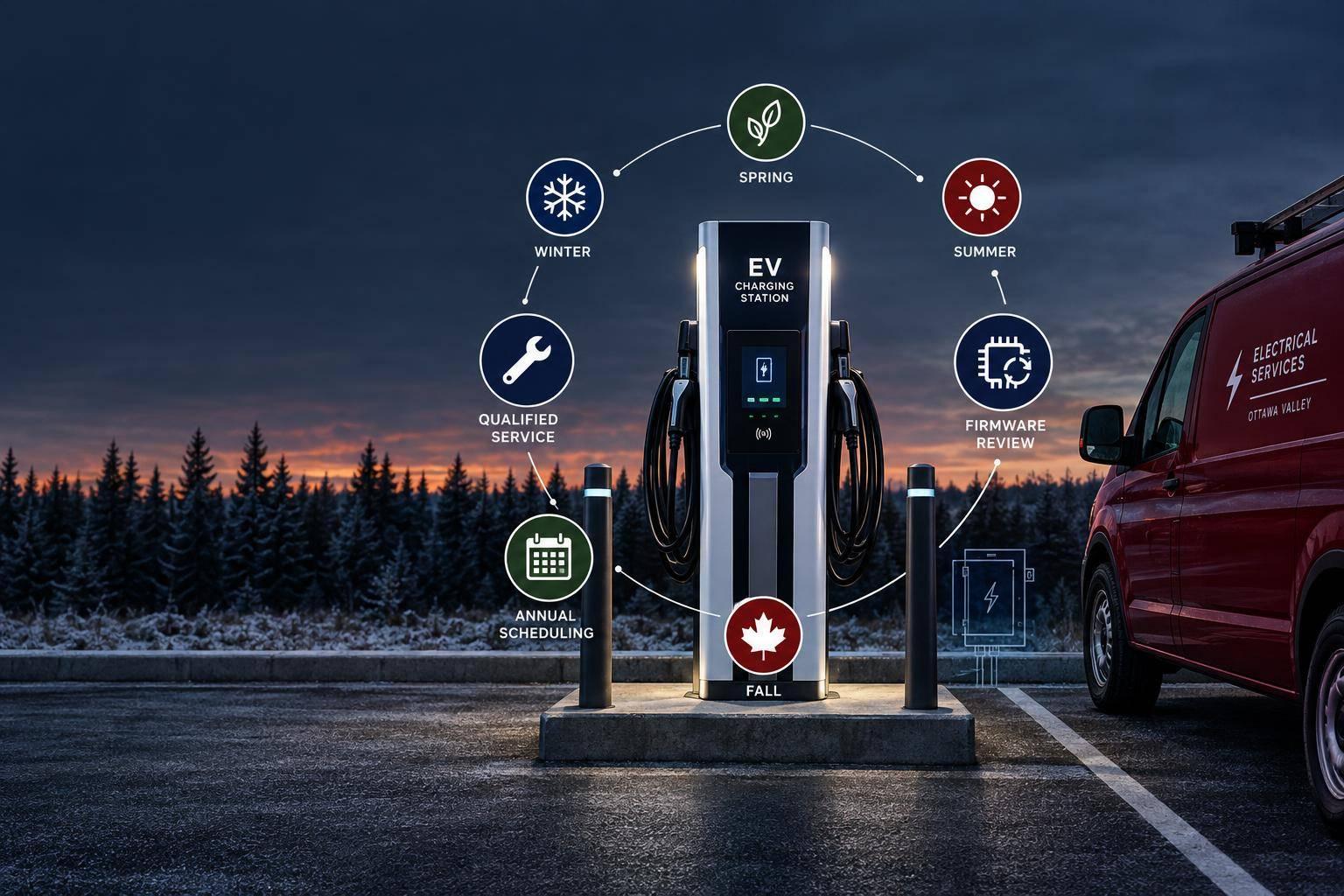
For Ottawa Valley homes and businesses, I build the plan around four tasks:
My rule: <u>stop using damaged or unsafe equipment</u>, and keep it out of service until repairs and testing are complete. The charger’s manual takes priority over a general calendar.
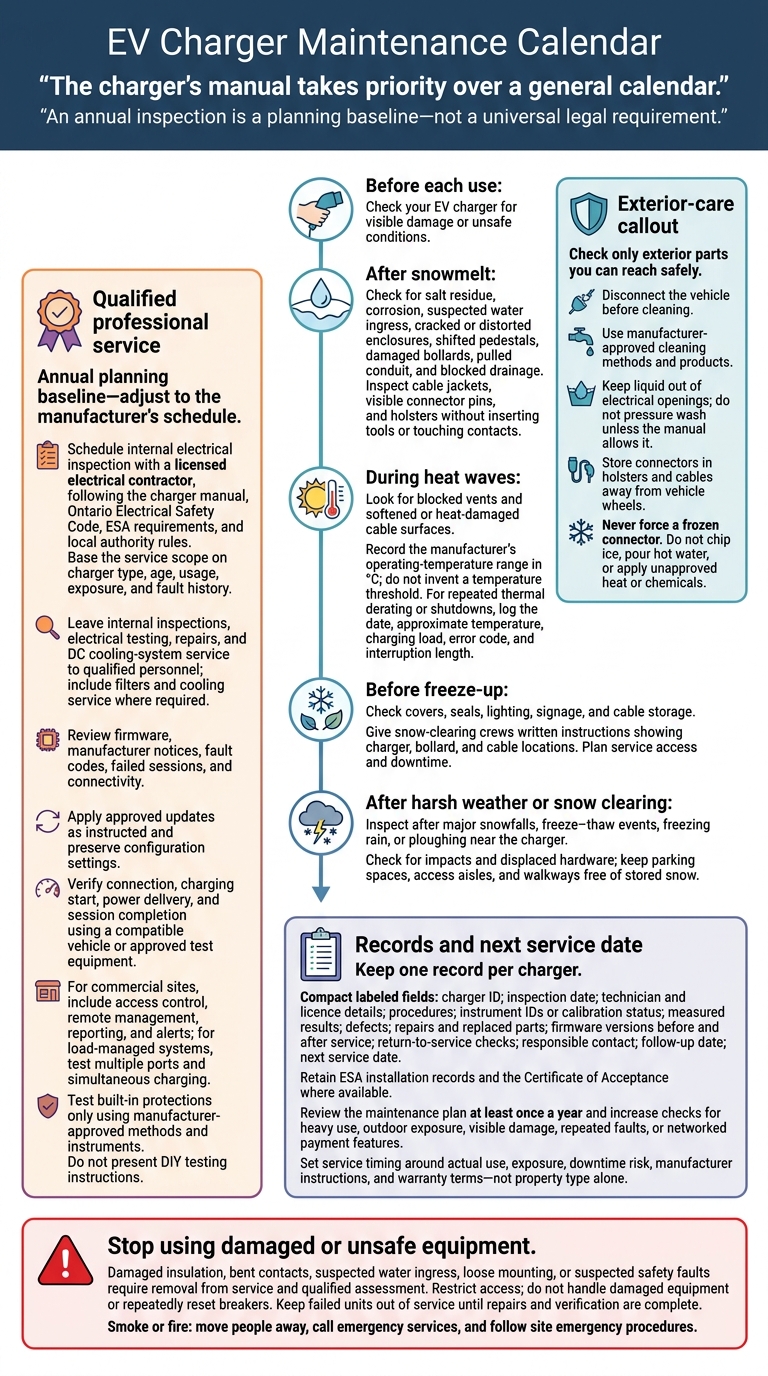
EV Charger Maintenance Calendar
In the Ottawa Valley, inspect chargers after snowmelt, during heat waves, before freeze-up, and after major snowfalls, freeze–thaw events, or snow-clearing damage. Check only exterior parts you can reach safely. Look for moisture or faults on displays. Where emergency stops are fitted, keep them visible and accessible, and follow the manufacturer’s procedure for any functional test.
Log every defect, even if it doesn’t need a repair. Use the same charger ID and checklist for each seasonal inspection.
After snowmelt, check for salt residue, corrosion, water ingress, cracked or distorted enclosures, shifted pedestals, damaged bollards, pulled conduit, and blocked drainage. Inspect cable jackets, visible connector pins, and holsters without inserting tools or touching contacts.
Take any unit with damaged insulation, bent contacts, suspected water ingress, or loose mounting out of service until qualified personnel inspect it.
During hot weather, look for blocked vents and softened or heat-damaged cable surfaces. Record the unit’s operating-temperature range in °C – an outdoor rating doesn’t mean it can handle every condition. If thermal derating or shutdowns happen repeatedly, record the date, approximate temperature, charging load, error code, and interruption length for the service technician.
Before freeze-up, turn to the seals, lighting, and access items on the same checklist.
Before freezing weather, check covers, seals, lighting, signage, and cable storage. Give snow-clearing crews written instructions showing charger, bollard, and cable locations. Keep parking spaces, access aisles, and walkways free of stored snow. After ploughing, check for impacts and displaced hardware.
Handle stiff cables gently, and never force a frozen connector. Remove loose snow only as the manufacturer permits. Don’t chip ice, pour hot water, or apply unapproved heat or chemicals. Once access checks are complete, clean only the exterior surfaces the manufacturer allows.
Disconnect the vehicle before cleaning the exterior. Use only manufacturer-approved cloths, brushes, and cleaning products on panels, screens, holsters, and ventilation grilles. Keep liquid out of electrical openings, and don’t pressure wash unless the manual allows it.
Without opening enclosures, check latches, hinges, gaskets, strain reliefs, mounts, and retractors for damage or movement. Store connectors in their holsters, and keep cables off the ground and away from vehicle wheels. Exterior care helps keep chargers in service; leave all internal cleaning and service to qualified personnel.
After inspecting the exterior, move to the internal electrical review.
Schedule an annual internal inspection with a licensed electrical contractor, following the charger manual, the Ontario Electrical Safety Code, ESA requirements, and local authority rules. Set the scope based on the charger’s type, age, usage, exposure, and fault history. Owners should supply fault logs and failed-session records.
Follow safe isolation procedures before inspecting connections, conductor insulation, grounding and bonding, panel capacity, disconnects, overcurrent protection, and the enclosure rating. Compare voltage or current measurements with equipment ratings and limits.
Test only the charger’s built-in protections, using manufacturer-approved methods and instruments. These may include ground-fault protection, temperature protection, interlocks, or emergency stops. Do not perform insulation-resistance testing unless the manufacturer explicitly permits it and specifies the method.
Record the firmware version and review manufacturer notices, fault codes, failed sessions, and communication interruptions. Apply approved updates as instructed, preserve configuration settings, and schedule downtime if needed.
Afterwards, use a compatible vehicle or approved test equipment to verify the connection, charging start, power delivery, and session completion. At commercial sites, also check access control, remote management, reporting, and alerts. For load-managed systems, test multiple ports and simultaneous charging.
Use the same charger ID and record format established in the maintenance calendar. Record the inspection date, charger ID, technician and licence details, procedures used, instrument IDs or calibration status, measured results, defects, repairs, and replaced parts. Include firmware versions before and after service, along with return-to-service checks.
Retain ESA installation records and the Certificate of Acceptance where available. Assign each unresolved issue to a contact and set a follow-up date.
Keep failed units out of service until repairs and verification are complete. Let recurring faults, outages, and connector wear guide repair or replacement decisions. Use the findings to set the next repair priority and service date.
Schedule service around use, exposure, and downtime risk – not property type alone. Start with an annual calendar, then adjust it for site conditions and planned outages.
Factor in charging frequency, public access, weather exposure, vandalism risk, equipment type, and the manufacturer’s instructions. Manufacturer instructions take priority over a general calendar. DC fast chargers may also need specialist service for cooling systems and filters.
Changes in use, exposure, and how long you can go without charging should guide schedule changes.
| Planning factor | Home chargers | Commercial chargers |
|---|---|---|
| Usage intensity | Base the schedule on actual charging frequency. | Review each port’s use and the effect of downtime. |
| Professional service | Plan a documented annual inspection as a baseline, or sooner if required. Keep service dates, fault history, and receipts together. | Follow manufacturer-directed servicing and add seasonal site checks. Keep service records, tickets, and repair approvals. |
| Monitoring | Assign someone to report faults and book repairs. | Name contacts to acknowledge alarms, escalate repairs, and communicate downtime. |
| Site conditions and downtime planning | A sheltered unit may need exterior service less often than an exposed one. Keep the charging area clear and plan service access. | Check exposure at each location. Coordinate parking restrictions, access permissions, and outage notices. |
Book planned work before freeze-up, peak demand, renovations, electrical upgrades, or relocation. Arrange parking closures, tenant notices, and shutdown windows. Get an electrical assessment before moving a charger or changing its circuit.
Assign responsibility for monitoring faults, approving repairs, clearing snow, and managing downtime. Confirm contractor availability and parts support ahead of time.
Even with a service schedule, a charger needs to come out of use at the first sign of trouble.
Stop using the charger immediately if you suspect a safety fault. Restrict access and arrange for qualified personnel to diagnose the fault, isolate the equipment, and repair it. Don’t handle damaged equipment or repeatedly reset breakers.
If there’s smoke or fire, move people away, call emergency services, and follow the site’s emergency procedures.
Contact Draper Electric to discuss EV charger maintenance, troubleshooting, and outage planning for Ottawa Valley homes and businesses.
Provide the charger model, power rating, fault history, photographs taken safely, access requirements, and preferred outage window. Confirm support for your charger model, especially manufacturer-specific DC chargers or network services. Ask for a written scope that covers expected downtime, parts, testing, documentation, and any required inspections.
Review your maintenance plan at least once a year. Follow the manufacturer’s service intervals, and check more often if the charger sees heavy use, outdoor exposure, visible damage, repeated faults, or has networked payment features. In the Ottawa Valley, add checks after snowmelt, freezing rain, or ploughing near the charger.
Use the checklist below to keep the annual review in one record.
Person responsible: ______ Completion date: ______ Notes: ______ Corrective-action #: ______ Next due date: ______
Annual EV charger maintenance costs aren’t standardized. Plan for routine inspections by a qualified electrical professional to help keep your system safe and extend its service life.
For help setting a maintenance schedule and getting an accurate estimate for your charger setup, contact Draper Electric. Their team provides electrical maintenance services for residential and commercial clients throughout the Ottawa Valley.
Missed maintenance could void your charger’s warranty. Manufacturers often require regular upkeep and proper installation to keep coverage in place. Improper care or do-it-yourself (DIY) work can also create safety hazards and cause equipment failure.
Keep records of regular professional inspections to help show you’ve met the warranty terms. Draper Electric provides professional maintenance to keep your charger in good condition and help prevent problems that could affect your coverage.
Replace your EV charger if it shows serious damage, such as cracks, burns, discolouration or exposed wiring. Frayed cables, damaged plugs or a charger that feels warm to the touch call for immediate replacement for safety.
Replacement is also needed if the charger malfunctions or a licensed electrician identifies internal faults or high-risk issues that routine maintenance can’t fix. Contact Draper Electric for professional diagnostics and troubleshooting.