Electrical Products & Services
Choose batteries by required loads and winter performance; confirm compatibility, approvals and a site-specific design before buying.
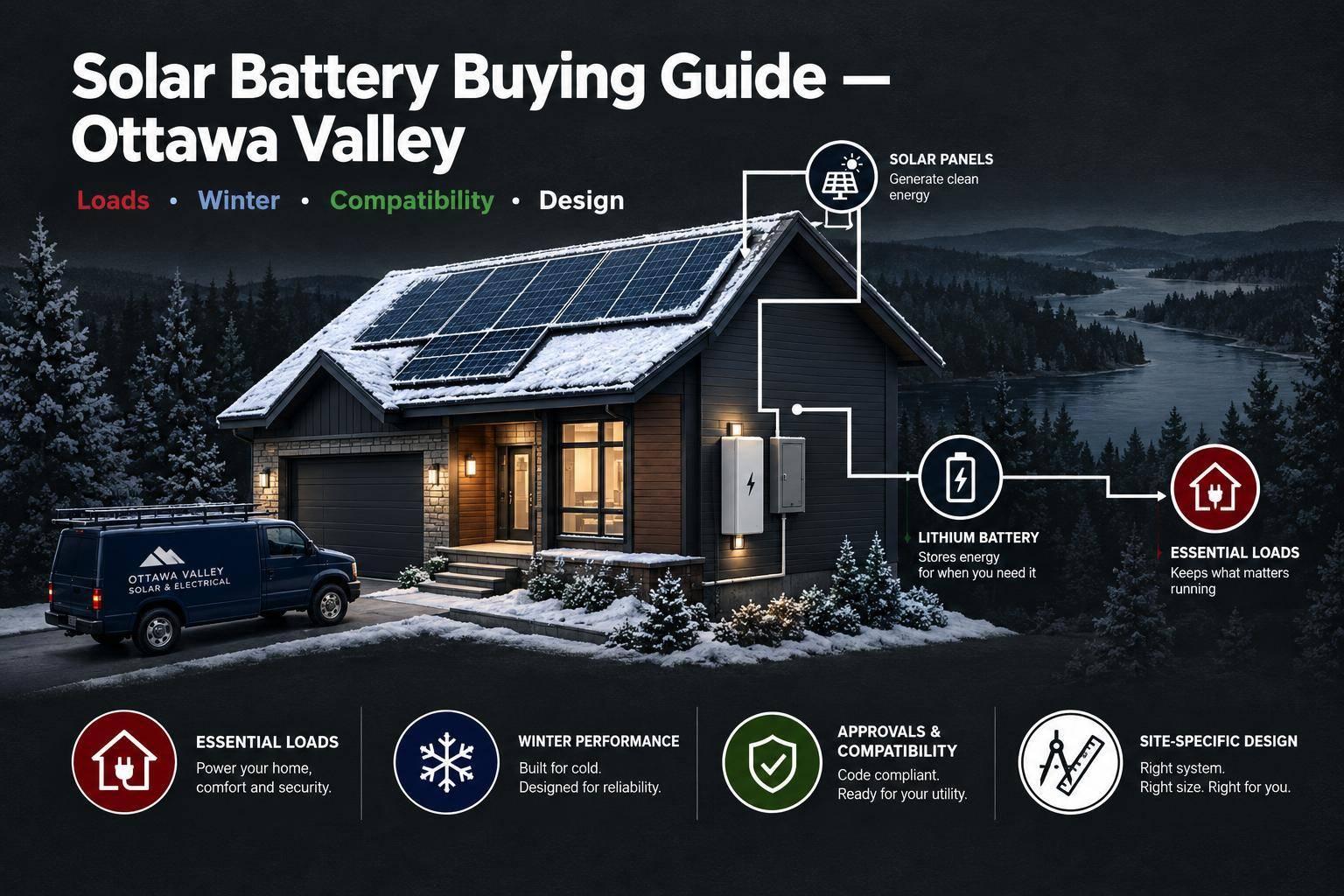
I’d choose a solar battery by what it must keep running – not its advertised capacity. Start with your furnace blower, fridge, pumps and lights, then plan for a 12-, 24- or 48-hour outage. Battery capacity (kWh) sets runtime; output (kW) limits what can run at once.
Before paying a deposit, I’d check:
My rule: <u>get the site-specific design and service terms in writing before buying</u>. A battery can cover selected loads, but whole-home backup through a long winter outage is a different task.
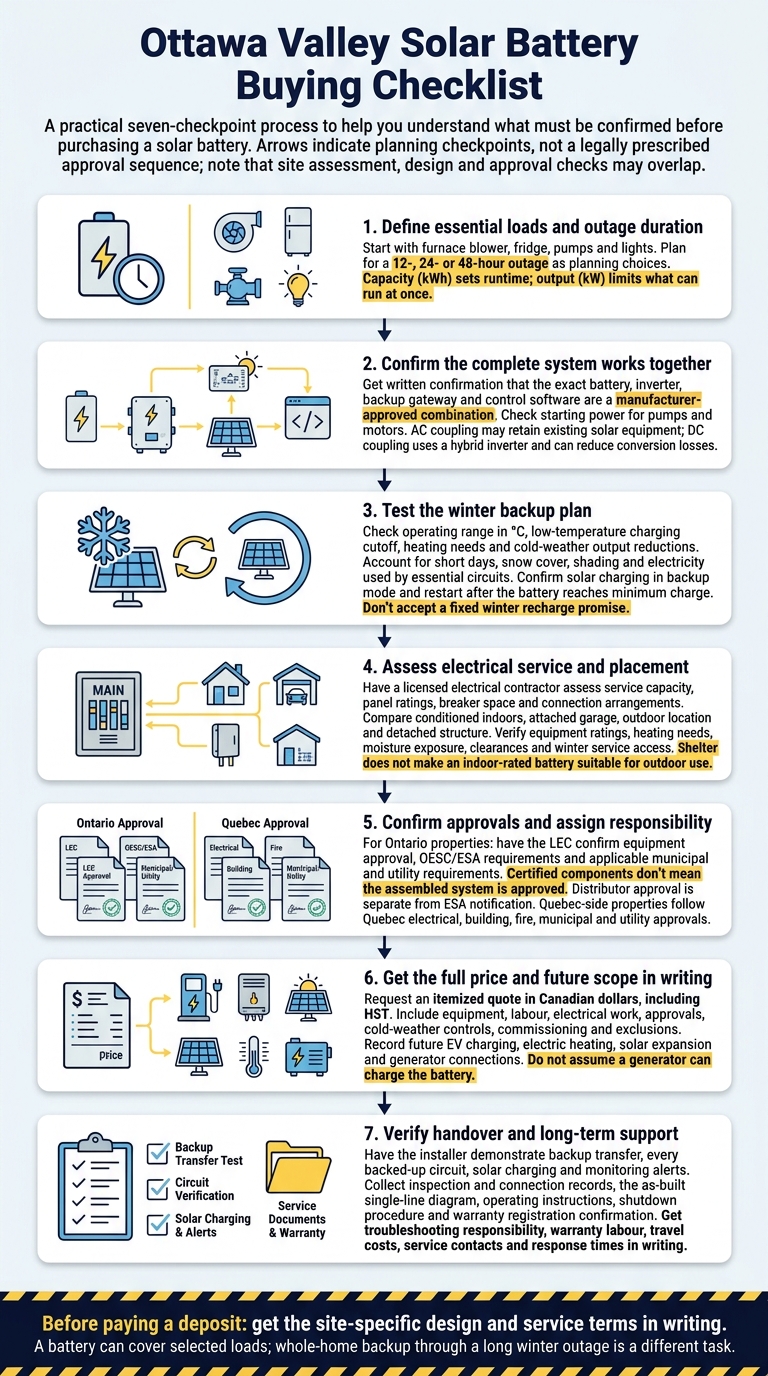
Ottawa Valley Solar Battery Buying Checklist
Once you’ve sized capacity and runtime, check that the battery, inverter and solar array can work together.
Use the kWh and kW targets above to match all three components as one system.
AC coupling adds a battery inverter on the home’s AC side, often letting you keep existing solar equipment. DC coupling connects storage through a hybrid inverter and can reduce conversion losses.
Before buying, get written confirmation that the exact battery, inverter, backup gateway and control software are a manufacturer-approved combination. Matching ratings alone isn’t enough.
| Check | AC-coupled system | DC-coupled system |
|---|---|---|
| Existing equipment | The existing solar inverter may stay if it supports backup operation | The existing inverter may need replacement with a compatible hybrid inverter |
| Electrical compatibility | Verify voltage, phase, frequency, breaker ratings, and solar inverter communication and control | Check string voltage against the MPPT operating range; verify maximum input and short-circuit current |
| Winter design | Confirm the battery inverter can control or limit solar output during outage-only operation | Check cold-weather open-circuit voltage; panel voltage increases as temperature falls |
| Expansion | Confirm approved battery quantities, parallel operation and communications | Confirm supported modules, battery voltage range, inverter current and software limits |
Once you’ve confirmed compatibility, check how the system will charge when Ottawa Valley winter conditions reduce solar output.
Most grid-tied solar systems shut off during an outage unless the battery system can establish the backup power supply. Charging during an outage requires a battery inverter or hybrid inverter that can create that supply, plus compatible controls that isolate the property from the utility.
The proposed design must explain how the solar inverter runs safely in backup mode and how the system manages loads when demand exceeds available backup power.
Ask for a site-specific outage-charging assessment that accounts for Ottawa Valley’s short days, snow cover and shading, as well as array size, roof orientation and tilt. It must subtract electricity used by essential circuits – not assume every bit of solar production reaches the battery. Don’t accept a fixed winter recharge promise.
Have the installer document solar restart after the battery reaches minimum charge. Confirm the required reserve, whether restart is automatic, and whether it needs utility power or manual intervention. During consecutive cloudy days, the controls may otherwise lack the power needed to restart solar charging.
If the system passes the technical checks, confirm that your electrical service can support it and get a clear price for the work.
A licensed electrical contractor should assess service capacity, panel bus ratings, breaker space, conductor ratings and connection arrangements. Depending on the findings, you may need a service upgrade, load-shedding controls or a separate backup-loads panel. Adding storage doesn’t automatically mean you need a larger service.
Request an itemized quote in Canadian dollars covering equipment, labour, panel and service work, load controls, approvals, heating or cold-weather control, commissioning and HST. It should state who handles ESA and utility coordination and list exclusions, such as trenching, concrete pads, structural work and communications wiring.
With the hardware and service plan set, check placement and winter performance.
Once you’ve sized the system, its location and operating temperature help determine how well it performs through an Ottawa Valley winter.
Check the battery’s operating range in °C, its low-temperature charging cutoff and how much its output drops in cold weather.
Winter runtime depends on heating demand, cold-weather output reductions and usable capacity. Ask for a site-specific estimate that accounts for battery heating and your actual loads – not just nameplate capacity.
Match the battery’s ratings to the site conditions before choosing a location. Shelter does not make an indoor-rated battery suitable for outdoor use. Have the installer check the following before choosing a cable route or mounting position:
| Location | Temperature and moisture checks | Access and installation checks |
|---|---|---|
| Conditioned indoors | Verify temperature control and check for condensation or flooding exposure | Confirm clearances and service access |
| Attached garage | Treat an unheated garage as a cold-space installation; assess heating needs and condensation | Check for snow buildup near doors and cable runs |
| Outdoor location | Use outdoor-rated equipment only; assess heating needs, wind-driven snow, ice and flooding | Keep disconnects and service space accessible; protect cables from weather |
| Detached structure | Verify cold-weather suitability, condensation control and water exposure | Assess winter access and the cable route between buildings |
Set your outage plan before winter. Battery backup rarely supports sustained electric space heating, so long outages call for major load cuts. Include heat-pump auxiliary heat when deciding which loads to back up.
With placement fixed, the installer can confirm the Ontario approval path and utility connection rules.
Once you’ve chosen the battery location, sort out approvals before placing your order.
Ask your Licensed Electrical Contractor (LEC) to check the complete battery system against the OESC, ESA guidance and the manufacturer’s instructions. Request certification to ANSI/CAN/UL 9540 from a certification body accredited by the Standards Council of Canada.
Certified components don’t mean the assembled system is approved. UL 9540A is a fire-propagation test method, not a replacement for UL 9540 system certification. If the system needs field evaluation or an SPE-1000 approval route, get ESA confirmation before buying. Also agree on who will arrange and pay for the evaluation.
Have your LEC check the electricity distributor’s current connection rules, including pre-approval, applications, metering, export limits and operating controls. Specify whether the battery will run in backup-only, non-export or grid-export mode. A non-export setting doesn’t automatically remove connection requirements, and distributor approval is separate from ESA notification.
Location affects approval as much as performance. Have your LEC check the proposed site against the OESC, ESA guidance and the manufacturer’s manual. Confirm current restrictions covering bedrooms, sleeping-area walls, crawlspaces, below-grade locations, self-closing doors, smoke alarms, exits and service space.
ESA residential ESS guidance identifies 1 m of separation from dwelling-unit or residential-occupancy windows and doors, except a vehicular-access door, for batteries installed indoors or outdoors. Ask your LEC to verify the rule, product markings and any applicable exceptions.
Also confirm the 20 kWh grouping limit, 1 m spacing between groupings and at least 1 m of clear working space. The manufacturer’s instructions may require more clearance.
Agree on who handles each approval task before design starts.
| Party | Responsibility | Documents to retain |
|---|---|---|
| Owner | Define backup/export goals, disclose constraints and authorize applications | Scope, site information and signed contract |
| LEC | Check product approval and clearances, prepare wiring plans, submit notification and arrange inspection | Product labels, drawings, notification and inspection record |
| ESA | Review notified work and inspect OESC compliance | Inspection or closure documentation |
| Municipality | Determine applicable building, zoning and municipal permits | Permit, plans and final inspection record |
| Electricity distributor | Authorize interconnection, metering, export and operating conditions | Approval letter, connection agreement and meter documentation |
| Fire authority | Review larger, commercial or higher-risk systems where required | Fire review, emergency plan and correspondence |
An ESA notification doesn’t replace municipal, fire or utility approval. For Quebec-side properties in the Ottawa Valley, follow Quebec electrical, building, fire, municipal and utility approvals. Name the jurisdiction and responsible authority in the written proposal.
Buy only after the design, approvals and scope are confirmed. Define which loads need backup power and for how long. Assess winter conditions, then check equipment compatibility, safe placement and required approvals. Get a site-specific electrical design before scheduling installation, inspection and commissioning.
Once the design and approvals are set, book the site visit. Have a Licensed Electrical Contractor check the service size, mounting support and access to disconnects. Request a single-line diagram and a written estimate of winter runtime. Before work starts, ask Draper Electric to confirm the installation scope, who handles permits and what equipment support is included.
At handover, check that the installed system matches the approved design. Collect the inspection and connection records, as-built single-line diagram, equipment labels, operating instructions, shutdown procedure and warranty registration confirmation.
Have the installer demonstrate the system: backup transfer, every backed-up circuit, solar charging and monitoring alerts.
The service agreement should spell out inspection intervals, firmware support, access requirements and battery-health reviews. It should also name who handles troubleshooting, warranty labour, travel costs, replacement and end-of-life recycling or disposal. Get service contacts and response times in writing.
Account for future loads now, before final sizing and sign-off. Record any planned solar expansion, EV charging, electric heating and business loads.
Before adding a generator or transfer switch, have a professional check compatibility and controls, including backfeed protection and battery-charging limits. Do not assume a generator can charge the battery. Do not pay a deposit until the full design and service terms are confirmed.
List the devices you need to keep powered and each device’s running wattage. Add those wattages, multiply the total by 24 hours, then divide by 1,000 to get kilowatt-hours (kWh). This assumes every device runs continuously for 24 hours.
Factor in the battery’s depth of discharge, which limits how much of its capacity you can use. Choose a system with built-in heating or a cold-climate rating. Have a licensed electrician check your calculations, system sizing and compliance with local electrical codes.
Whether you can add batteries depends on your equipment’s design. Many modern systems let you add battery packs as your energy needs grow. Others restrict which models or generations you can combine.
A licensed electrician at Draper Electric can check whether your inverter and batteries support expansion, based on your system design, load requirements and local electrical codes in the Ottawa Valley.
As your battery ages, it stores less energy, so backup runtime gets shorter. Frequent charge-and-discharge cycles, deep discharges and conditions around the battery can affect its health. Battery management systems track voltage and temperature to help optimise performance and lifespan.
Many manufacturers guarantee that the battery will retain around 80% of its capacity after a set number of years or cycles. Even with this warranty, expect your system to power your home for less time during outages as the battery ages.