Electrical Products & Services
Frequent trips, dimming lights, warm outlets, burning smells or buzzing often mean a circuit is overloaded. Fix it before fire risk.
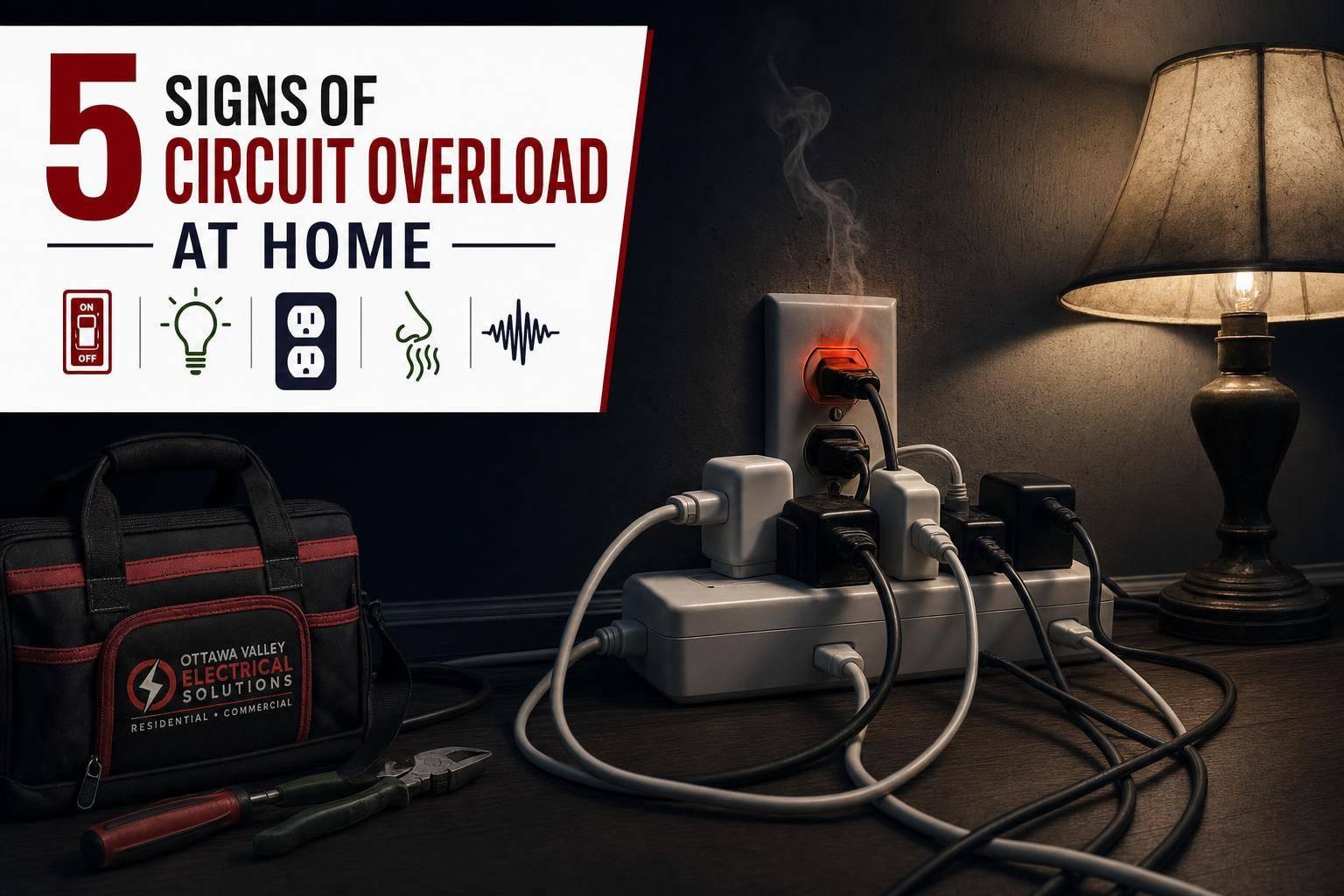
If a breaker keeps tripping, lights dim when appliances start, or an outlet feels warm, I treat it as a warning sign of circuit overload. In many Canadian homes, especially older ones with 60-amp or 100-amp service, one overloaded 15-amp circuit can hit its limit fast. A standard 15-amp circuit handles about 1,800 watts, so a 1,500-watt space heater can use most of that on its own.
Here’s the short version of what I’d watch for:
What I’d do first:
These signs often show up together, not one at a time. So if I notice even one of them, I’d treat it as a home safety issue, not just a minor electrical annoyance.
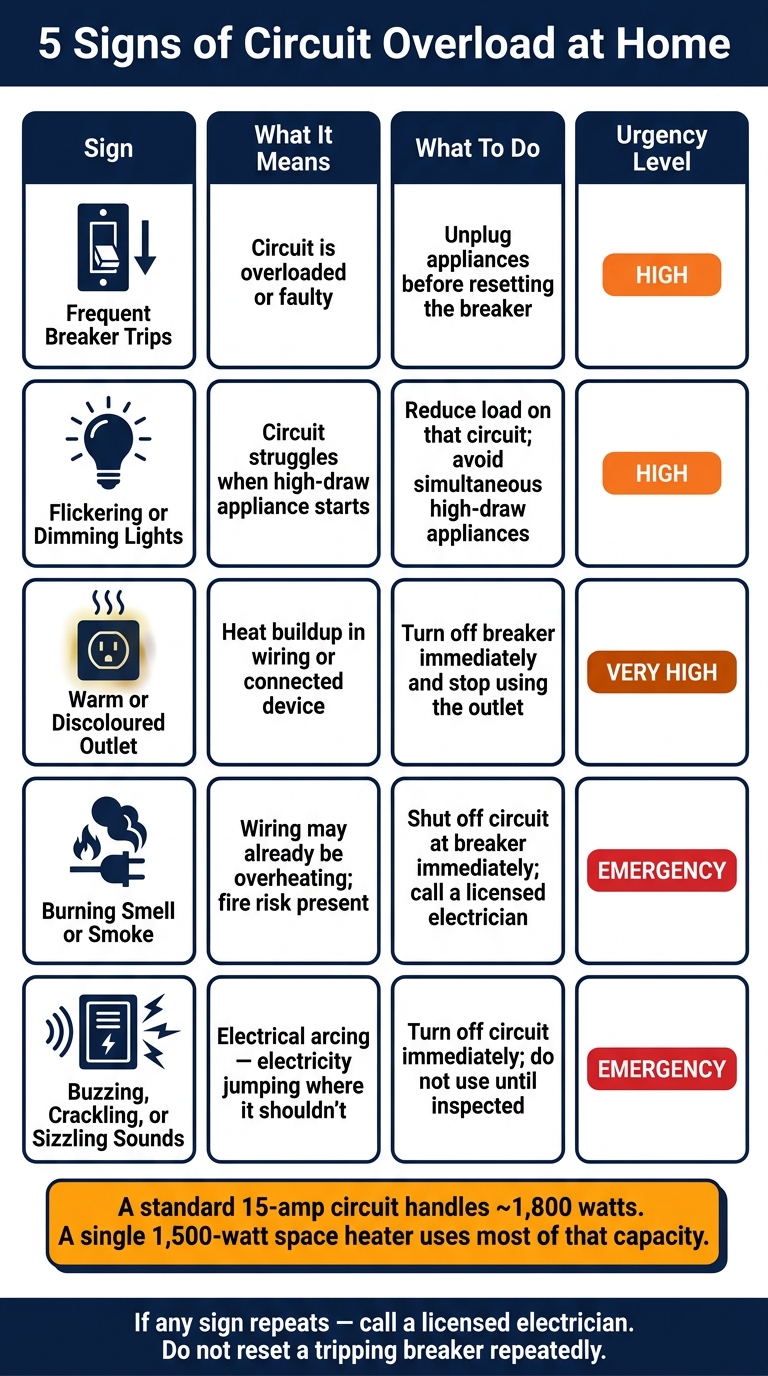
5 Signs of Circuit Overload: Symptoms, Causes & What to Do
| Sign | What it can mean | What I’d do right away | Urgency |
|---|---|---|---|
| Breaker trips often | Circuit is overloaded or faulty | Unplug appliances before resetting | High |
| Lights dim or flicker | Circuit struggles when load starts | Cut back load on that circuit | High |
| Warm or discoloured outlet | Heat buildup in wiring or device | Turn off breaker and stop using it | Very high |
| Burning smell or smoke | Wiring may be overheating | Shut off circuit at once | Emergency |
| Buzzing or crackling | Arcing or heat damage | Leave circuit off and call for help | Emergency |
If I see these warning signs at home, the next step isn’t guesswork. It’s to lower the load, shut the circuit down if needed, and get it checked.
Many older Canadian homes, especially ones with 60-amp or 100-amp electrical service, were built for a time when people used far less power than they do now. Back then, homes weren’t set up for today’s busy kitchens, bathroom appliances, and work-from-home setups.
A 15-amp circuit can handle about 1,800 watts. That sounds like a lot until you plug in a 1,500-watt space heater. At that point, you’ve already used most of the circuit’s capacity.
The problem gets worse when there aren’t enough dedicated circuits. Then several high-draw appliances end up sharing the same line. A common example is a microwave, toaster, and coffee maker running on the same kitchen circuit. If they’re used at the same time, the circuit can overload fast.
Canadian winters put even more strain on home electrical systems. Space heaters often get plugged into circuits that are already close to their limit. When overloads happen again and again, they can wear down wire insulation and create a hidden fire risk.
In many homes, the first sign is simple: breakers that trip often.
If the same breaker keeps tripping, the circuit is likely overloaded or faulty. In most cases, that breaker is doing its job: it’s protecting a circuit that’s carrying too much load.
This often happens when several high-draw appliances share one circuit.
The breaker trips without much warning and cuts power to part of the home. It often happens under the same conditions, especially when several appliances are running at once. If the lights on that same circuit also dim or flicker, the overload is already putting stress on the wiring.
Repeated overloads heat the wiring and can damage the insulation over time. That can create a hidden fire risk behind the walls.
Before you reset a tripped breaker, unplug the high-draw appliances on that circuit first. If the breaker trips again after you reset it, don’t keep flipping it back on. Contact a licensed electrician for an assessment. If the breaker keeps tripping, the next warning sign often shows up at the lights and outlets.
Lights that flicker or dim once in a while aren’t always a major problem. Sometimes it’s just a loose bulb. But if the lights dim right when an appliance turns on, pay attention. That usually means the circuit is having a hard time handling the load.
Overload often shows up in the lights first. If one circuit is feeding several appliances, the lights on that same circuit usually react before anything else does. When a high-draw appliance starts up, it can pull voltage down on the circuit and make the lights dim.
There’s often a clear pattern. The lights dip when the appliance starts, then come back once it’s running at a steady level. Or they stay dim the whole time the appliance is on. That pattern matters more than one random flicker.
Repeated overloads can overheat wiring and damage insulation behind the walls.
Cut back the load on that circuit and have it checked by a licensed electrician. For now, avoid using multiple high-draw appliances on the same circuit at the same time, like a microwave and a toaster. Have the circuit checked before you use those appliances together again. If the circuit also feels hot, the issue is getting worse.
If flickering lights are the first hint, the outlet is often the next place trouble shows up. A warm outlet cover or a switch plate that has turned yellow or brown usually points to overheating inside the circuit. Treat any warm or discoloured outlet as an immediate warning sign.
This often happens when too many high-draw devices are running on the same circuit. Common culprits include space heaters, power bars, and extension cords being used as permanent wiring.
It can get worse when power bars are plugged into each other or when extension cords are left in place long term. That setup puts extra strain on the circuit and can lead to heat buildup behind the wall.
You may spot:
Turn off the circuit at the breaker, unplug everything connected to it, and stop using the outlet right away. Then call a licensed electrician to inspect the outlet and the wiring.
If you also hear noise from the outlet or switch, the issue may be getting worse.
Once heat turns into a burning smell, smoke, or visible marks, this is an emergency. If you notice a burning smell near an outlet, switch, or panel, shut off the circuit and call for service right away. That usually means the wiring may already be overheating, and nearby framing or insulation could catch fire.
Repeated overloads can lead to arcing between conductors. That can leave scorch marks, create smoke, and damage the outlet or wiring behind it.
You may notice:
Turn off the affected circuit at the breaker panel immediately. If the outlet is scorched or smoking, leave the circuit off until a licensed electrician inspects it and fixes the damage.
If you also hear buzzing or crackling, the circuit is likely under serious stress.
If you can already see heat or damage, unusual noise is the next big warning sign.
Buzzing, crackling, or sizzling from an outlet, switch, or breaker panel is serious. In many cases, those sounds point to electrical arcing. That means electricity is jumping where it shouldn’t, which can overheat wiring and start a fire.
A common cause is a circuit pulling more current than it was built to handle. When that happens, the wiring can heat past safe limits. Over time, that heat may wear down the insulation around the wires and make arcing more likely.
Sometimes, the sound is the first clue that something’s wrong, even before you spot visible damage. You may also notice:
Turn off the circuit right away and don’t use it again until it has been inspected.
At this point, stop using the circuit and shut it off at the breaker. If you hear buzzing, crackling, or sizzling, shut off the circuit and call a licensed electrician.
If you spot any of these signs, stop adding more load to the circuit right away. Unplug high-draw appliances at once. For example, a space heater can overload a standard 15-amp circuit in no time.
Using extension cords or chaining power bars together to run several appliances? Stop there. Move high-draw devices to different circuits around your home instead. If an outlet or switch feels hot or has a burnt smell, skip straight to shutting it down.
Don’t keep using any outlet or switch that feels warm, looks discoloured, or smells burnt. Turn off the affected breaker and leave it off until a licensed electrician has checked it.
When heat turns into smoke or noise, treat it like an urgent problem. Smoke, scorch marks, or buzzing, crackling, or sizzling mean you should shut off the circuit immediately and call a licensed electrician.
When the same warning signs keep coming back, it’s not a small issue anymore. If a breaker trips again and again, lights still flicker after you cut the load, or an outlet feels warm, call a licensed electrician.
If the circuit starts giving off heat, smoke, or strange sounds, stop using it right away. Burning smells, smoke, scorch marks, and buzzing, crackling, or sizzling noises are emergency signs.
A licensed electrician can test whether the circuit or panel can safely handle the load, inspect the panel, and repair or upgrade overloaded circuits.
For a safe inspection and repair, call a licensed electrician. Draper Electric serves Ottawa Valley homes with overload inspections, circuit troubleshooting, and panel upgrades.
Any one of these five warning signs – tripped breakers, flickering lights, warm outlets, burning smells, or strange sounds – can point to a circuit carrying more load than it should. And in many cases, one overloaded circuit shows up in more than one way at the same time.
This matters because overload damage builds slowly. Circuit overloads are a common cause of electrical fires in Canadian homes, and the damage often starts quietly, long before you can see it.
Treat these signs as a safety issue. Act fast. When overload signs show up, the next step is inspection – not guesswork.
If your home has older 60-amp or 100-amp service, a load calculation can show whether it can handle your current demand. Draper Electric can assess load capacity, troubleshoot overloaded circuits, and recommend panel upgrades. Draper Electric provides troubleshooting and panel upgrades for Ottawa Valley homes.
Yes. A circuit overload can start a fire.
When too much electrical current flows through a circuit, the wiring can heat up past safe limits. That heat can melt the wire insulation, expose live conductors, and set nearby combustible materials on fire.
In plain terms: too many devices on one circuit can make the wires run hot. And once that heat builds up, the risk moves from a tripped breaker to smoke, melted plastic, or an actual fire.
Your panel may be too small if you often deal with tripped breakers, dimming or flickering lights, warm outlets or switch plates, or burning smells.
Those warning signs can point to a simple issue: your home is pulling more power than the panel can handle. When that happens, an electrical panel upgrade or a few added circuits may be needed.
Usually, no. A breaker that keeps tripping is often a sign of an overload or another safety issue. Resetting it might feel like a fast fix, but doing that again and again without finding the cause can be dangerous.
If it keeps happening, shut off the circuit and contact a licensed electrician. They can check whether the issue comes from too many appliances on one circuit or a wiring fault.