Electrical Products & Services
Seven checks to verify contractor licences, manufacturer training, ESA permits, equipment approvals, commissioning and service records.
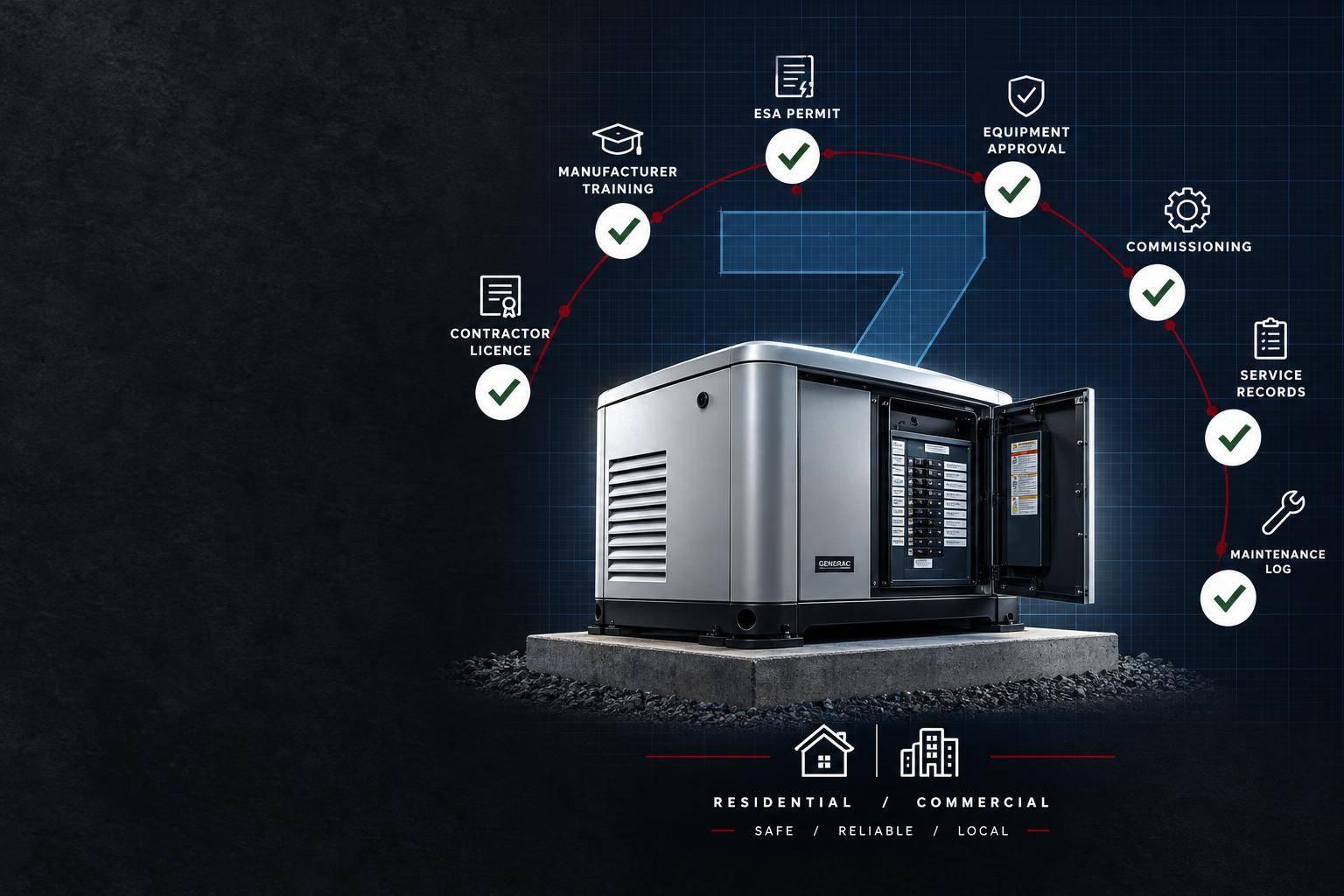
Before hiring a generator contractor in Ontario, check the licence – and ask for proof of training, equipment approval and inspection. No single document confirms all four.
These 7 checks help property owners verify the work from hiring through handover:
Keep the records in one project file, and resolve missing or conflicting details before accepting the work.
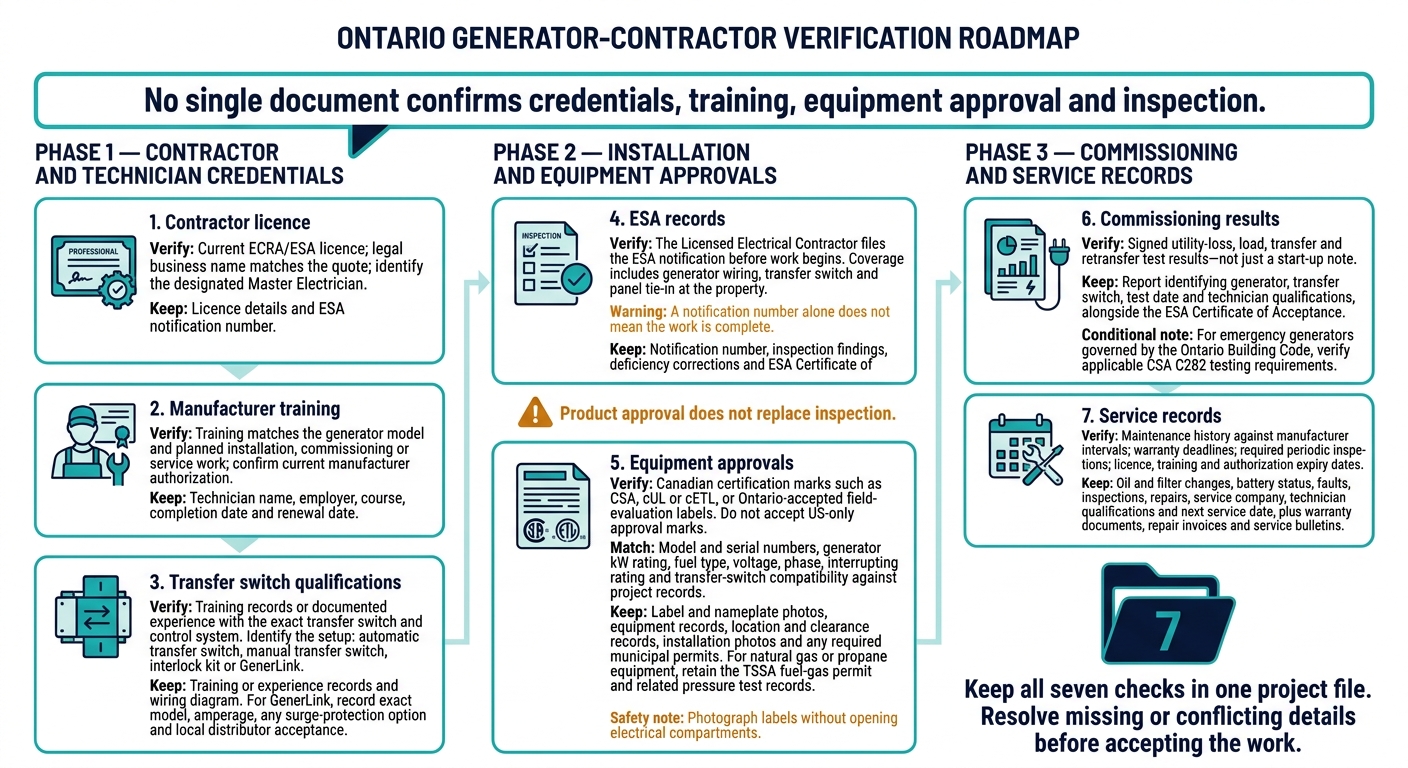
7 Generator Certification Checks in Ontario
Check the contractor first, then verify the technician’s training and credentials for the equipment being installed.
Look up the contractor in ESA’s contractor locator using their licence number. Check that the legal business name matches the quote and that the licence is current. Ask who will serve as the designated Master Electrician overseeing the project.
For hired electrical work, confirm that the Licensed Electrical Contractor files the ESA notification before work begins and handles the inspection close-out. Don’t agree to file as a homeowner for work the contractor performs. Keep the licence details and notification number in your records.
Ask for manufacturer training records showing the technician’s name, employer, completed course, completion date and renewal date. The training should match both the equipment and the work being done – installation, commissioning or service.
Verify current manufacturer authorization and save the records in the project file. Then check that the technician’s training also covers the exact transfer equipment on site.
Request training records or documented experience with the exact transfer switch and control system. Confirm which setup the project uses: an automatic transfer switch, manual transfer switch, interlock kit or GenerLink. Experience with one setup doesn’t mean the technician knows every automatic, manual or meter-mounted system.
At handover, collect the wiring diagram and verify grounding, bonding, interlocking and utility isolation. For GenerLink, record the exact model, amperage and any surge-protection option, and confirm acceptance by the local distributor.
Once you’ve checked the contractor’s credentials, confirm that the work was reported to ESA and inspected.
Make sure the ESA notification covers your property and the generator wiring, transfer switch, and panel tie-in – not just the generator unit. Check ESA’s current notification and inspection stages for the job.
Keep the notification number, inspection findings, deficiency corrections, and ESA Certificate of Acceptance. A notification number alone doesn’t mean the work is complete. ESA review also doesn’t replace the contractor’s responsibility to meet the Ontario Electrical Safety Code.
Next, check that the installed equipment matches the approved product records.
Check the generator and transfer equipment against ESA’s certification-marks guidance. Look for Canadian certification marks, such as CSA, cUL or cETL, or Ontario-accepted field-evaluation labels. Do not accept US-only approval marks. Photograph labels and nameplates without opening electrical compartments.
Match the model and serial numbers, generator kW rating, fuel type, voltage, and phase to the equipment schedule, warranty, and installation records. Confirm the interrupting rating and transfer-switch compatibility, too. Resolve any differences before accepting the handover documents.
Keep location and clearance records, installation photos, and any required municipal permits for concrete pads or enclosures. For natural gas or propane equipment, also retain the TSSA fuel-gas permit and related pressure test records. Product approval doesn’t replace the required inspection.
Once the equipment passes approval and inspection, check that it was properly commissioned and tested. Before handover, request signed commissioning results, not just a start-up note. The record should identify the generator and transfer switch, include the test date, and confirm the technician’s qualifications.
Check for documented utility-loss, load, transfer, and retransfer test results. File the ESA Certificate of Acceptance with the commissioning report. For emergency generators governed by the Ontario Building Code, verify that testing meets the applicable CSA C282 requirements.
After commissioning, review the maintenance records and record document expiry dates. Compare service dates against the manufacturer’s maintenance intervals. The service log should cover oil and filter changes, battery status, faults, inspections, and repairs. Each entry should identify the service company and technician, state the technician’s qualifications, and include the next scheduled service date.
Keep warranty documents, repair invoices, service bulletins, and the ESA Certificate of Acceptance together in one file. Track warranty deadlines and required periodic inspections, along with expiry dates for licences, training, and authorizations.
Keep one project file for all seven checks, and update it as each document arrives.
Each document proves only what falls within its scope. Before accepting the work, put any missing or conflicting details in writing and ask the issuer for a corrected document.
For Ottawa Valley projects, request that same documentation before work begins. Ottawa Valley property owners can discuss generator and transfer-switch work with Draper Electric. Ask for the qualifications and project documents that apply to the specific work you’re arranging.
Ask the contractor or technician for proof of completed manufacturer’s training for the exact generator or transfer switch model installed. Make sure the records are current, include the training date and provider, and cover the components they service, such as ATS/GenerLink components.
Also check that the work has the proper ESA permits and that the licensed contractor includes documented service records in your installation or maintenance package.
Do not proceed if your installer refuses to provide ESA documents. In Ontario, every permanent standby generator installation requires an ESA electrical permit, no matter its size. A Licensed Electrical Contractor must file the notification before work starts [1].
Check that your contractor has a valid electrical licence. Missing ESA paperwork can create safety risks, potentially void your warranty, and complicate your home insurance coverage and future resale [2][1].
Yes. In Ontario, replacing a transfer switch requires an electrical permit and a new ESA notification filed by a licensed electrical contractor. This applies to permanent standby generator systems of any installation size.
The replacement changes your electrical system and its connection to the generator, so an inspection is also required to confirm the work meets provincial safety standards.