Electrical Products & Services
Always prioritise safety: a four-step checklist to identify, isolate and verify sources of electrical noise before repairs.
My first rule for electrical noise: check for danger before looking for the cause. If you notice smoke, sparks, a burning odour or a shock, stay away. For fire or immediate danger, leave the area and call 911 from a safe location.
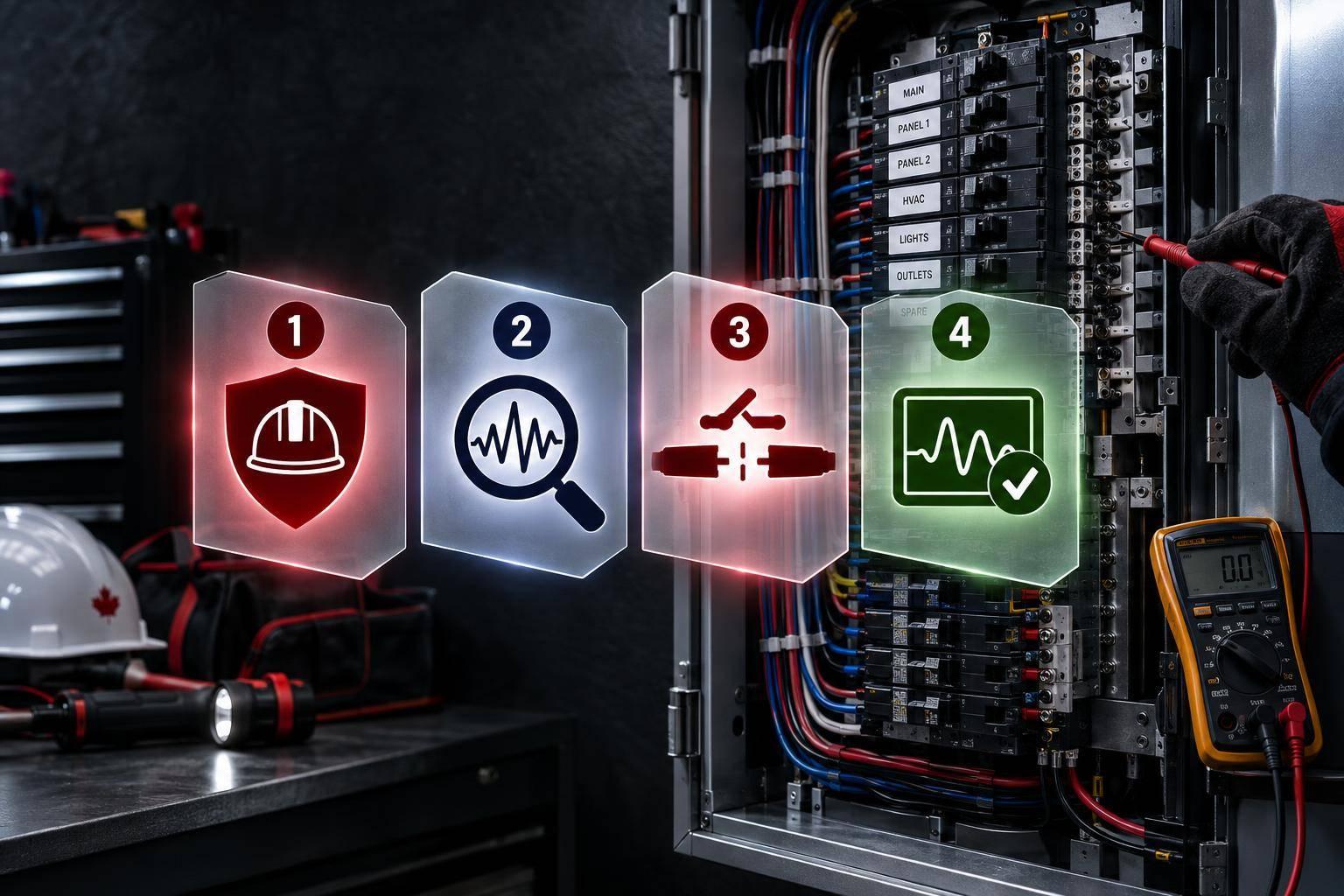
I use 4 steps to keep the process focused on safe observation – not DIY wiring repairs:
<u>Silence does not prove safety.</u> I treat a noise stopping as a clue – not confirmation that the fault is fixed.
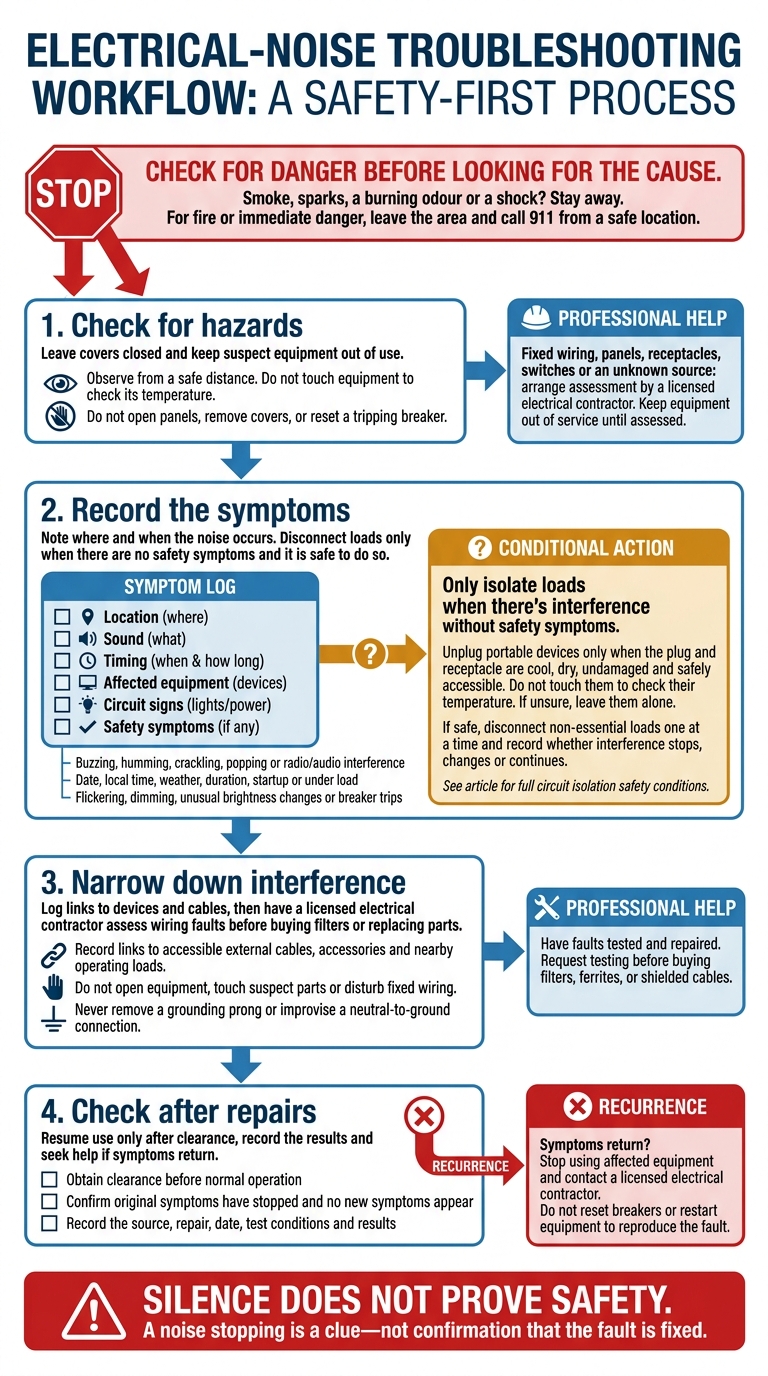
Electrical Noise Troubleshooting: 4 Safe Steps
Treat new or worsening electrical noise as a hazard. If the noise is happening now, check for immediate danger from a safe distance before documenting anything.
If no immediate hazard is visible, keep the equipment isolated and move to the next safety check.
Keep covers in place. While waiting for a licensed electrical contractor, do not open panels or remove panel covers, plates or enclosures. Do not insert tools or tighten connections.
Keep unsafe equipment off. Do not touch, reconnect, reset, re-energize or upsize it. Arrange an assessment by a licensed electrical contractor if the noise comes from fixed wiring, panels, receptacles, switches or an unknown source. Keep the equipment out of service until it has been assessed.
Once the equipment is left safe, record what you heard and when it happened.
Once the area is safe, record the noise and isolate loads one at a time.
Use the log below to note whether the problem affects one device, a known circuit or several areas. If helpful, add photos taken from a safe distance.
A detailed log helps narrow the source to one load, one circuit or interference affecting several areas.
| Observation | What to record | Why it matters |
|---|---|---|
| Location | Room, receptacle, light or panel | Documents the affected area |
| Sound | Buzzing, humming, crackling, popping or radio/audio interference; steady or intermittent | Describes the symptom |
| Timing | Date, local time, weather, duration and whether the noise begins at startup or occurs under load | Records operating conditions |
| Affected equipment | Devices running, including chargers, motors, lighting controls and heaters | Records loads operating at the same time |
| Circuit signs | Flickering, dimming, unusual brightness changes, breaker trips or buzzing | Documents accompanying signs |
| Safety symptoms | Heat, burning odour, smoke, sparks, shocks or tingling | Shows when isolation must stop |
Only isolate loads when there’s interference without safety symptoms.
If the noise follows a circuit rather than one device, isolate that circuit only under the conditions below.
Noise stopping does not prove safety. A loose connection or deteriorated conductor may remain. Give your log and isolation results to a licensed electrician to help trace the source.
If the noise changed or stopped after isolation, trace the remaining path before replacing anything.
Identify power cords, coaxial, Ethernet, telephone, USB, and audio/video cables, along with docks, adapters, and splitters. Match each cable to your logged symptoms. Check accessible parts for fraying, crushed insulation, corrosion, or heat marks. Do not open equipment or touch suspect parts.
Reconnect one known-good accessory at a time, following the manufacturer’s instructions. Record which connection brings the interference back. Move cables only if they’re accessible, de-energized, and undamaged. Do not disturb fixed wiring. Use your findings to link the noise to nearby loads.
Check whether interference occurs when nearby motors, variable-speed drives, dimmers, switching power supplies, welders, or high-current loads are running. In workshops and businesses, record the machine name, operating mode, and start time.
Ask a licensed electrician to assess grounding, bonding, and connections. Never remove a grounding prong or improvise a neutral-to-ground connection. Use these findings to guide the repair.
Take faulty appliances and damaged cords to qualified service providers for repair or replacement. In Ontario, have a Licensed Electrical Contracting Business assess noisy, loose, overheated, or damaged wiring, receptacles, switches, breakers, and lighting controls. Leave grounding and bonding repairs, internal connections, and circuit changes to qualified professionals.
Request testing before buying filters, ferrites, or shielded cables. The fix needs to match the source, frequency, cable route, and equipment design. For Ottawa Valley properties, Draper Electric can test and correct the fault. Share your connection findings to help distinguish equipment interference from a building-wiring fault.
After isolating the fault and completing repairs, check the fix under normal operating conditions. Use your hazard check, symptom log, isolation results and repair record to confirm the fault has cleared before returning the equipment to service.
If symptoms return, check the log for the last change that triggered them.
If the repair does not fully clear the noise, get further help.
Stop using affected equipment if symptoms return. Do not reset breakers or restart equipment to reproduce the fault. For smoke, fire, serious shock or immediate danger, leave the area and call 911 from a safe location.
Normal electrical humming is usually quiet and comes with no other warning signs. A fault is more likely if you hear buzzing, crackling or popping, or notice hot panels or outlets, warm outlet covers, flickering lights, burning or burning-plastic smells, scorch marks, discoloured outlets, corrosion or frequent breaker trips.
If you notice any of these signs, unplug devices and turn off the affected circuit, if you can do so safely. Contact a licensed electrician for an inspection.
Yes. LED bulbs can cause electrical interference if they aren’t compatible with the dimmer switch. This can lead to strobing or buzzing. Start by checking that the bulb is screwed in securely. If the bulb is faulty, replace it.
Draper Electric provides professional electrical troubleshooting for homes and businesses in the Ottawa Valley to help resolve these issues.
Yes, especially if the noise changes when they use equipment that draws a lot of power, or if there are problems with shared or nearby wiring or grounding. Note when the noise occurs and whether it affects lights, fans or outlets.
Watch for buzzing, crackling, flickering, burning smells or warm or hot areas on the electrical panel. If you hear unusual sounds or notice dangerous odours, turn off the affected circuit if it’s safe to do so and contact a licensed electrician for an inspection.