Electrical Products & Services
Annual generator checklist for standby units: battery, fluids and filters, transfer-switch testing, enclosure cleanout, and alarm review.
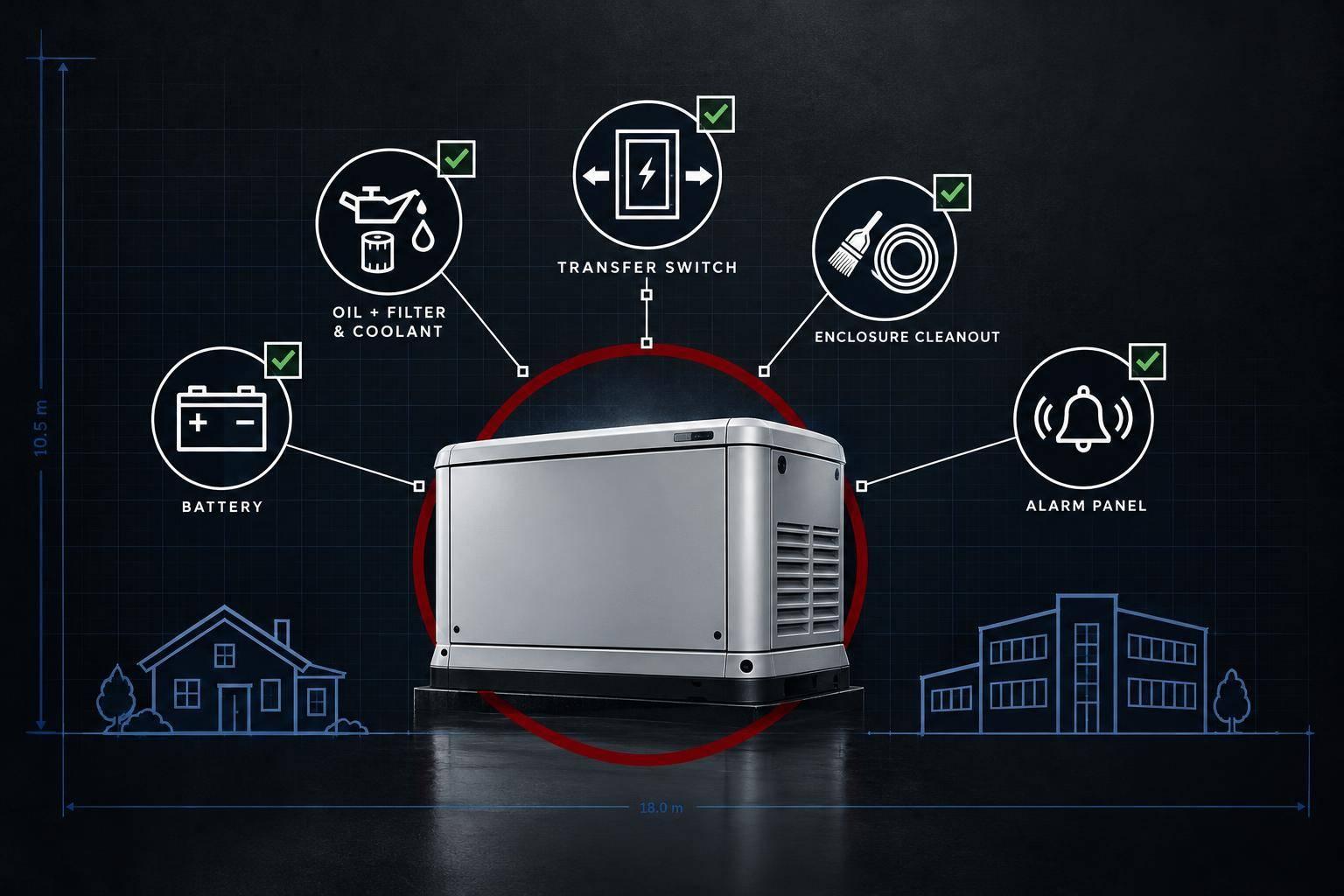
I plan yearly generator service before severe weather – or sooner if the manufacturer’s operating-hour limit comes first. For an Ottawa Valley generator, I focus on 5 areas:
My rule: a generator that starts still needs testing. I keep owner checks external, record results and repairs, and confirm standby settings after testing. <u>Unsafe or faulty equipment stays out of automatic service</u> until cleared by a qualified technician. Then I set the next service date and arrange any follow-up with Draper Electric.
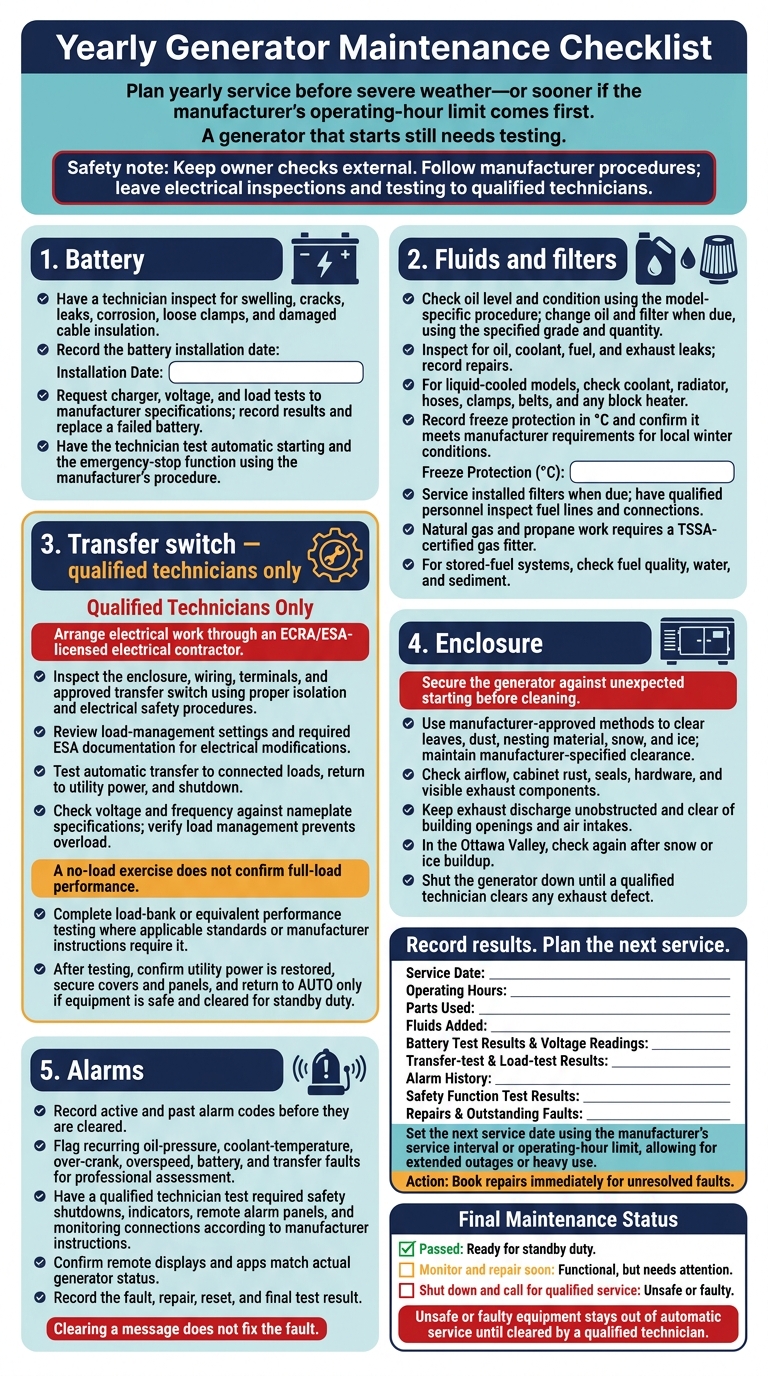
Yearly Generator Maintenance Checklist
Have the technician inspect the battery for swelling, cracks, leaks, terminal corrosion, loose clamps, and damaged cable insulation. Record the installation date.
Appearance alone won’t tell you whether the battery has enough capacity. Request charger, voltage, and load tests to the manufacturer’s specifications. Record the results and replace the battery if it fails testing.
The technician should also test automatic starting and the emergency-stop function using the manufacturer’s procedure. Complete these checks before winter puts more demand on the starting system.
Check the oil level and condition using the procedure for your model. Change the oil and filter when due, using the specified oil grade and quantity. Inspect for oil, coolant, fuel, and exhaust leaks, and record any repairs.
For liquid-cooled models, check the coolant level and concentration, radiator condition, hoses, clamps, belts, and any block heater. Record freeze protection in °C and confirm it meets the manufacturer’s requirements for local winter conditions.
Service installed filters only when they’re due. Have qualified personnel inspect fuel lines and connections. Natural gas and propane work requires a TSSA-certified gas fitter.
For stored-fuel systems, especially commercial diesel units, check fuel quality and look for water and sediment contamination.
After the engine-side checks, move to transfer switch testing.
Once engine-side checks are complete, move on to transfer-switch testing.
Qualified technicians only: transfer switches and energized equipment pose risks of shock, backfeed, and equipment damage. Arrange electrical work through an ECRA/ESA-licensed electrical contractor.
Have the technician follow proper isolation and electrical safety procedures when inspecting the enclosure, wiring, terminals, and approved transfer switch. They should also review load-management settings and confirm that any electrical modifications have the required ESA documentation.
If the inspection passes, proceed with controlled transfer and output testing.
Have the technician test automatic transfer to connected loads, return to utility power, and shutdown. They should check output voltage and frequency against nameplate specifications and verify that load management prevents overload when large loads start.
A no-load exercise does not confirm full-load performance. Have the technician complete a load-bank or equivalent performance test where applicable standards or manufacturer instructions require it.
After the test, restore normal standby settings and document any faults.
Schedule testing to minimize disruption to critical loads. Afterwards, have the technician confirm that utility power is restored, return the equipment to AUTO, secure all covers and panels, and record test results and outstanding repairs. Do not return faulty equipment to automatic operation.
After the mechanical checks, clean the enclosure and check the exhaust path. Secure the generator against unexpected starting before cleaning. Use manufacturer-approved methods to remove leaves, dust, nesting material, snow, and ice from the enclosure and vents. Keep stored materials at the distance specified by the manufacturer. In the Ottawa Valley, check again after snow or ice builds up.
Inspect the cabinet for rust, damaged seals, and loose hardware. Check visible exhaust piping, the muffler, supports, and joints for damage. Keep the exhaust discharge unobstructed and clear of building openings and air intakes. Shut the generator down until a qualified technician clears any exhaust defect.
Review the control system for stored faults and safety shutdowns. Record active and past alarm codes before anyone clears them. Note recurring oil-pressure, coolant-temperature, over-crank, overspeed, battery, and transfer faults. These warnings need professional assessment, even if the message later disappears.
Have a qualified technician test the required safety shutdowns, indicators, remote alarm panels, and monitoring connections according to the manufacturer’s instructions. Confirm that remote displays and monitoring apps match the generator’s actual status. Checking stored faults, safety shutdowns, and remote status helps confirm standby readiness.
Record the fault, repair, reset, and final test result – clearing a message does not fix the fault.
After completing the checks, finish the service record. Document the battery, fluid, transfer-switch, enclosure, and alarm checks. Include the service date, operating hours, parts used, fluids added, battery test results and voltage readings, transfer-test and load-test results, alarm history, and safety function test results.
Set the next service date using the manufacturer’s service interval or operating-hour limit, allowing for extended outages or heavy use. Book repairs immediately for unresolved faults, before the next storm or winter outage.
Assign one final status based on the findings:
If any checklist issues remain unresolved, schedule service now.
Draper Electric provides generator and transfer-switch services in the Ottawa Valley. When you contact them about maintenance or troubleshooting, have your equipment details, service record, and any unresolved or uncertain findings ready.
Yes. Running your generator for long periods puts strain on it, so inspect it after an outage. Check for leaks, loose wiring, debris buildup, low oil levels and a clogged air filter.
If it ran for many hours during the outage, check your owner’s manual to see whether it’s due for an oil change or air filter replacement.
For portable generators, check the oil level before every use and run a manual test each month. Maintenance also includes changing the oil and filters, checking air filters for debris, and storing the unit in a dry, covered area.
Each week, check for rust, leaks, loose wiring, and blocked intakes. Use a multimeter to test the battery voltage, aiming for 12.4 V to 12.7 V, and remove corrosion from the terminals with a wire brush.
Schedule a professional load-bank test every year to check that your generator can handle your property’s full electrical load during an emergency without overheating or becoming unstable.
A licensed electrician must perform the test to avoid safety risks or voiding your warranty. Draper Electric offers generator maintenance, including professional load testing, for property owners in the Ottawa Valley.