Electrical Products & Services
Compare LED, HID and solar outdoor lighting for businesses—winter reliability, lifecycle costs, controls and Ontario code.
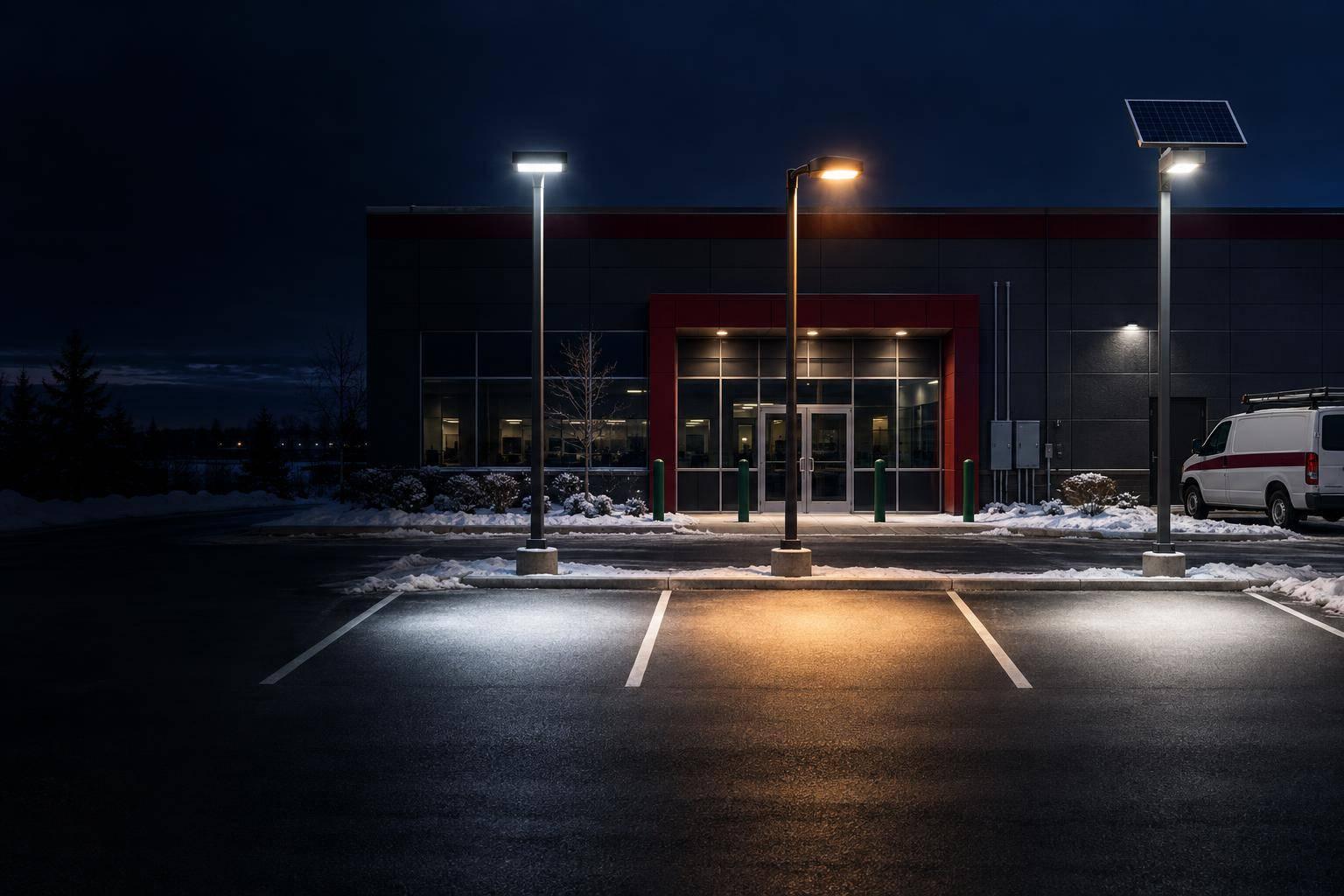
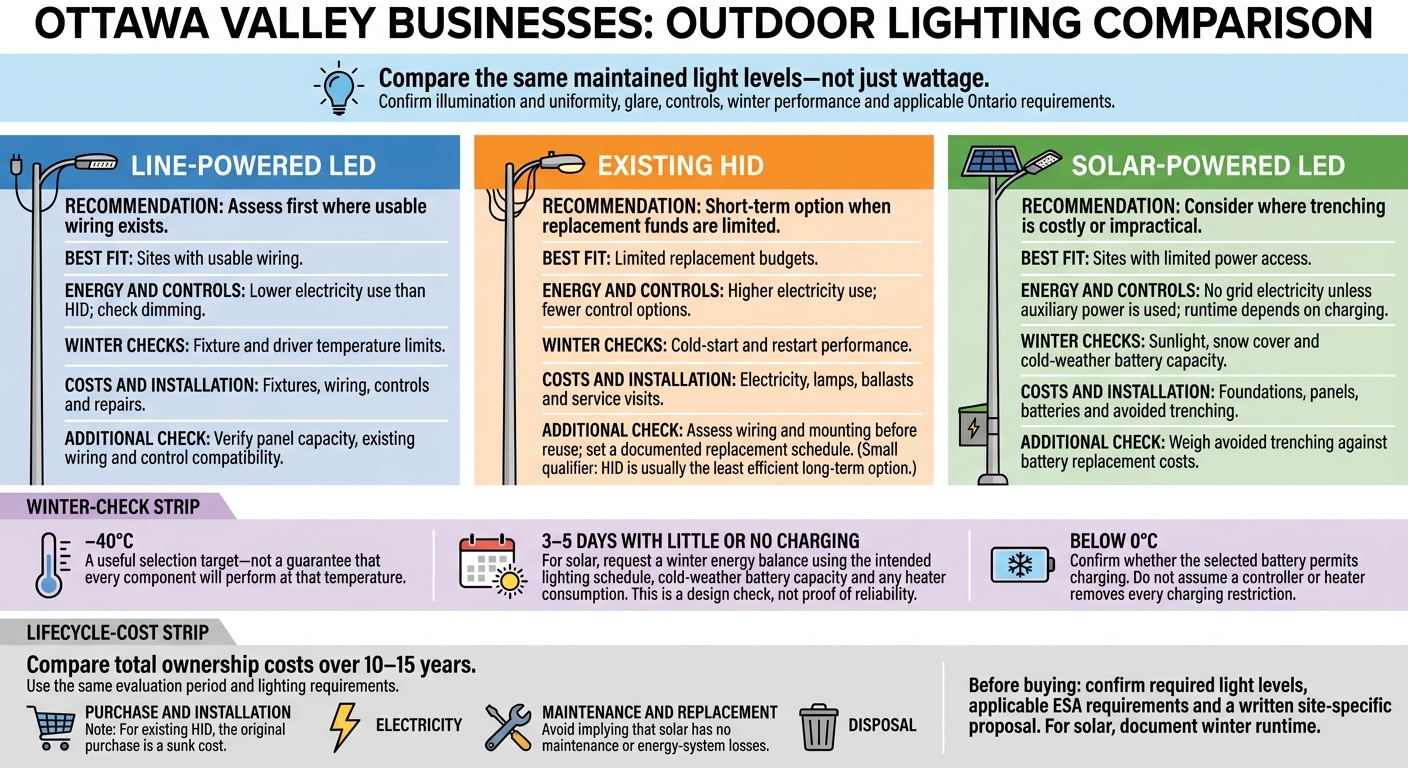
For an Ottawa Valley business with existing wiring, I’d assess line-powered LED first. I’d keep working HID only as a short-term option, and consider solar LED where trenching is costly or impractical.
My rule: compare the same maintained light levels, not just wattage. Then check glare, controls, winter performance, installation, Ontario code requirements and total costs over 10–15 years.
Quick Comparison
| What I’d compare | Line-powered LED | Existing HID | Solar-powered LED |
|---|---|---|---|
| Best fit | Sites with usable wiring | Limited replacement budgets | Sites with limited power access |
| Energy and controls | Lower electricity use than HID; check dimming | Higher electricity use; fewer control options | No grid electricity unless auxiliary power is used; runtime depends on charging |
| Winter checks | Fixture and driver temperature limits | Cold-start and restart performance | Sunlight, snow cover and cold-weather battery capacity |
| Costs and installation | Fixtures, wiring, controls and repairs | Electricity, lamps, ballasts and service visits | Foundations, panels, batteries and avoided trenching |
For solar, I’d request a winter calculation covering 3–5 days with little or no charging. For every option, I’d <u>confirm required light levels and ESA requirements before buying</u>.
Business Outdoor Lighting: LED vs HID vs Solar
If your site already has wiring, assess line-powered LEDs first. They use less electricity and can replace older HID systems. Specify dimming controls that lower output during quiet periods while keeping entrances and work zones properly lit. Calculate projected energy use at the proposed setting – not the fixture’s maximum rating.
Check each fixture’s weather rating and operating temperature range. Confirm that the driver and key components can be replaced. Schedule inspections to catch failed components, damaged housings and control faults before they disrupt site activity.
Compare installation, electricity and maintenance costs over the same period. Include fixtures, controls, wiring, access equipment and repairs – not just the equipment purchase. Check for available incentives before approving the retrofit.
Before approving the quote, review panel capacity, existing wiring and control compatibility. Confirm whether the site needs new circuits or panel upgrades. The work must meet Ontario Electrical Safety Code requirements and be performed by an ESA-licensed contractor.
For sites with older HID fixtures, the next section examines whether replacement still makes sense.
Existing HID lighting may need to stay in service if a full LED replacement isn’t possible yet. Metal halide and high-pressure sodium systems use more energy and offer fewer control options than modern LEDs. Before planning a retrofit, have the lamps, ballasts, wiring and mounting checked for compatibility.
Review lamp and ballast failures together with complaints about light output. At Ottawa Valley sites, include winter service calls: cold-weather failures can turn a low-cost repair into repeat visits. Prioritize fixtures that fail repeatedly or provide too little light.
Keeping HID can make sense in the short term when replacement funds are limited. But it delays replacement spending – not electricity use. Set a review date so the decision doesn’t stay open-ended.
Track electricity use, lamp changes, ballast repairs and service visits, then compare those costs with replacement costs. HID is usually the least efficient long-term option.
Ask Draper Electric to assess existing wiring and mounting before reusing them. Confirm which parts can stay, which need replacement and whether the work meets Ontario Electrical Safety Code requirements. Do not reuse HID mounting or wiring without a verified assessment.
If HID repairs are no longer cost-effective, compare solar-powered LED next – particularly where power access is limited.
Solar-powered lighting can avoid trenching on sites with limited power access. But first, you need proof that it will deliver enough light through winter.
Before choosing solar, confirm winter output, shade exposure and battery capacity. Ask for proof that the system maintains required light levels through Ottawa Valley winters, including when dimming or scheduling controls are in use.
Check cold-weather ratings for both batteries and fixtures, along with protection against moisture, wind and freeze-thaw conditions. Plan safe access for panel maintenance and battery replacement.
Follow the manufacturer’s instructions for mounting and wiring so both can accommodate expansion and contraction.
Avoiding supply trenching cuts excavation costs and site disruption, especially where existing infrastructure makes digging costly or impractical.
Compare those savings with installation, panel cleaning and periodic battery replacement costs. Ask for the expected replacement schedule: batteries are a major driver of long-term costs.
Before installation, have the site assessed for panel exposure, mounting requirements and measured light levels. Confirm applicable Ontario electrical approvals with the Electrical Safety Authority (ESA), and check municipal light-spill bylaws.
Compare lighting for parking areas, entrances, loading zones and signs at the same maintained illumination and uniformity – not the same wattage. Request manufacturer technical data and a site lighting calculation from commercial electrical services. Use the same site target for all three systems when comparing energy use and winter output, and carry these operating assumptions into the cost comparison that follows.
| Comparison factor | Line-powered LED | Metal halide / high-pressure sodium (HID) | Solar-powered LED |
|---|---|---|---|
| Total input power | Use fixture input watts, including driver losses. | Include ballast losses, not just lamp watts. | Record luminaire watts separately from charging and storage losses. Include those losses when sizing the system. |
| Efficacy | Verify whole-fixture lumens per watt. | Use whole-fixture data that accounts for lamp ageing. | Verify luminaire efficacy separately from solar-system performance. |
| Start-up and restrike | Instant-on within its documented operating rating. | Warm-up and restart delays depend on the lamp and ballast. | Instant-on depends on available battery power. |
| Dimming | Check driver and control compatibility. | The existing lamp and ballast must support dimming. | Check controller settings and how they affect runtime. |
| Distribution and light quality | Obtain photometric files and light-quality data. | Assess installed optics and lamp specifications. | Require the same lighting data as for line-powered LED. |
Calculate estimated annual electricity use as total input watts × operating hours ÷ 1,000, using separate hours for each dimming level. Compare estimates with metered consumption over matching periods before describing savings as measured. Assess controls separately to compare their effect on operating hours and peak loads.
Check individual component ratings rather than relying on a general winter rating. Compare documented operating temperatures with Ottawa Valley conditions. A −40°C specification is a useful selection target, but it doesn’t guarantee that every component will perform at that temperature.
Component limits affect light output, reliability and winter service calls. Ask manufacturers for evidence covering operating temperatures, snow and ice exposure, maintenance requirements and warranty conditions.
| Equipment | Winter checks | Maintenance and service-life evidence |
|---|---|---|
| LED modules and drivers | Verify cold-start limits for the complete assembly. Check whether snow or ice can block the lens. | Keep LED lumen-maintenance ratings separate from driver and whole-fixture reliability. Request the temperature and operating-hour assumptions behind the rating. |
| HID lamps and ballasts | Verify the ballast’s minimum starting temperature and documented warm-up/restrike performance. | Set relamping and ballast replacement intervals using the actual lamp type, operating hours and condition – not a universal lifespan. |
| Solar panels | Check winter orientation, shading and snow blockage. | Account for access for inspection and cleaning. |
| Solar batteries and controllers | Verify charging and discharge temperature limits, heater demand and low-charge behaviour. | Request usable cold-weather capacity and warranty conditions. |
For solar, request a winter energy balance showing runtime through 3–5 days with little or no charging. Treat this as a design check, not proof of reliability. The calculation should use the intended lighting schedule, cold-weather battery capacity and any heater consumption.
Confirm whether the selected battery permits charging below 0°C. Don’t assume a controller or heater removes every charging restriction.
Compare total ownership costs over 10–15 years, using the same evaluation period and lighting requirements for each option. Request itemized quotes in CAD, current equipment prices, maintenance estimates and written warranty terms. For existing HID, treat the original purchase as a sunk cost – not a new expense. Check Ontario rebates before finalizing project costs and payback calculations.
| Cost to include | Line-powered LED | Existing HID | Solar-powered LED |
|---|---|---|---|
| Fixtures and controls | Fixtures or compatible retrofit kits; timers, sensors and commissioning | Relamping, ballast repairs and compatible controls | Luminaires, panels, controllers and batteries |
| Mounting and installation | Check reusable poles; price labour, wiring, trenching and surface restoration separately | Assess existing poles, wiring and required repairs | Price foundations, mounting and installation; deduct only avoided trenching |
| Electricity | Apply the business tariff to calculated consumption | Include lamp and ballast input | Include any auxiliary electrical input, if used |
| Maintenance and parts | Cleaning, access equipment, drivers and possible whole-fixture replacement | Cleaning, access equipment, lamps and ballasts | Cleaning, access equipment, batteries, controllers and LED drivers where applicable |
| Warranty and end of life | Confirm parts, labour and access coverage; price disposal | Price lamp, ballast and fixture disposal | Confirm battery coverage and price collection, recycling and disposal |
Reusing sound poles and wiring can cut installation costs. For solar, weigh the savings from avoided trenching against battery replacement costs. Keep maintenance assumptions, replacement timing and price changes consistent across longer-term comparisons.
With lifecycle costs mapped out, check whether the site can support each option.
Record fixture counts, input wattages and mounting heights in metres. Measure or model maintained illuminance in lux before choosing replacements. The electrical assessment should cover circuits, panel capacity, disconnects, grounding and exterior wiring. A lamp-only LED retrofit needs a documented compatibility check for the fixture, driver and controls.
| Site issue | Line-powered LED | Existing HID | Solar-powered LED |
|---|---|---|---|
| Infrastructure and disruption | Assess reusable circuits and poles; identify excavation and shutdowns | Identify deteriorated wiring, mounts and repair needs | Assess foundations, mounting location and maintenance access |
| Control integration | Check existing switching and control compatibility | Confirm lamp-and-ballast compatibility | Confirm controller compatibility |
| Winter service | Plan access for maintenance | Plan access for lamps and ballasts | Plan access for battery servicing |
| Compliance checks | Review ESA notification and any required approvals | Review repairs and proposed modifications | Confirm ESA requirements for the complete installation |
Before work begins, verify ESA notification and inspection requirements. Have a Master Electrician working through an ESA-licensed electrical contractor oversee the project. Draper Electric serves the Ottawa Valley for commercial electrical installation, maintenance and troubleshooting.
Once you’ve compared energy use, winter performance and lifecycle costs, let site conditions guide your choice.
| Site conditions | Best-fit option | Checks before committing |
|---|---|---|
| Existing electrical infrastructure; standard commercial retrofit | Line-powered LED | Energy savings, cold-weather performance, glare control and code compliance |
| Working HID system; limited replacement budget | Continued HID use with a planned replacement schedule | Remaining lamp life, repair costs and a documented replacement schedule |
| Remote site; trenching impractical | Solar-powered LED | Required light levels, winter runtime, sunlight access and battery lifecycle |
Choose the system that meets lighting, safety and winter reliability requirements at the lowest lifecycle cost. If two options still fit, pick the one that meets code and winter lighting targets with the least disruption.
Before buying, book a site assessment with Draper Electric. Confirm the required light levels and request a written proposal explaining how the selected system will meet them. For solar, the proposal should also document winter runtime.
To estimate your payback period in years, divide the upfront installation cost by your combined annual energy and maintenance savings.
Compare electricity bills before and after the upgrade to calculate energy savings. For maintenance savings, include avoided ballast replacement costs of $150 to $300 per fixture, including labour and lift rentals. Use these combined savings to assess whether the retrofit justifies the upfront investment.
Yes. Fixtures with optimized optics can reduce glare without compromising safety. In parking lots and commercial outdoor areas, dark-sky-compliant fixtures limit light spill and glare while providing enough light for people to navigate safely.
Modern LED retrofits also improve colour rendering, making it easier to see clearly and helping reduce eye strain.
Draper Electric can help you choose suitable fixtures and ensure the installation meets safety codes.
Ontario businesses may qualify for cash incentives and technology rebates through demand response programs that reduce peak electricity use. Local utilities may also offer rebates for energy-efficient upgrades, including ENERGY STAR-certified equipment.
Offers change, so check your local utility’s website before buying materials or starting installation. Draper Electric can help install lighting retrofits that meet these programs’ technical requirements.