Electrical Products & Services
Estimate home and public EV charging costs in Canada, including TOU rates, charging losses, time to charge, and cost per 100 km.
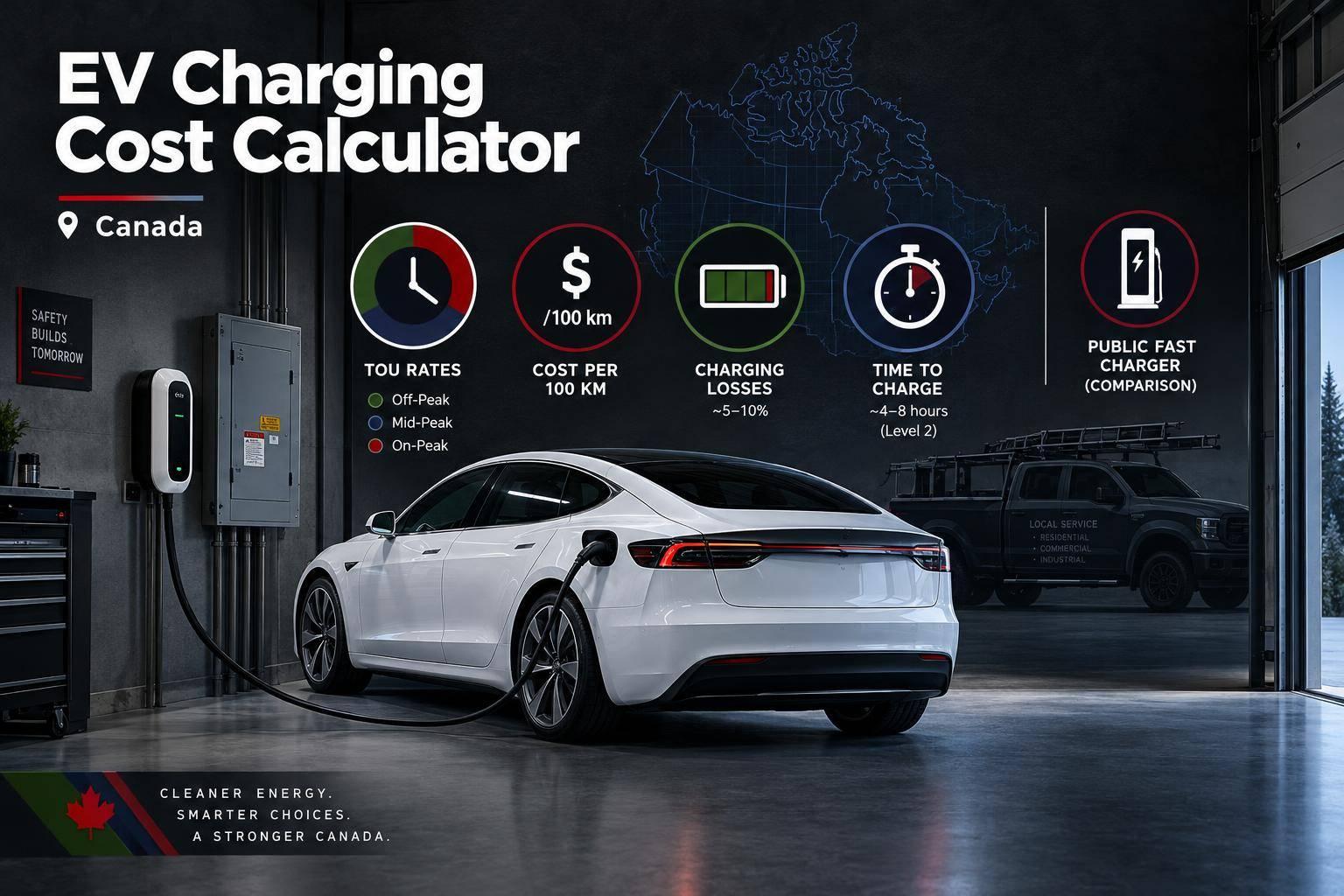
An EV Charging Cost Calculator can make day-to-day charging decisions a lot easier, especially when electricity prices vary by province, utility, or time of day. Whether you charge at home overnight or top up at a public station, it helps to know how much energy your vehicle actually needs and how much power will be drawn from the grid once charging losses are included.
This tool estimates the cost to charge an electric vehicle based on battery size, current and target charge levels, charger type, and your electricity rate. It also shows approximate charging time, which is useful when comparing home charging with public Level 2 or DC fast charging.
A good EV Charging Cost Calculator goes beyond simple battery math. Real charging sessions are affected by temperature, battery condition, and the power limits of both the vehicle and charger. If you enter your vehicle’s efficiency, you can also estimate cost per 100 km, giving you a clearer view of what electric driving may cost in everyday Canadian conditions.
For drivers trying to compare rates, plan road trips, or manage monthly charging costs, an EV Charging Cost Calculator offers a quick and practical estimate.
It’s a solid estimate for planning, budgeting, and comparing charging options, especially if you use your real electricity rate and a realistic charging efficiency. That said, real-world results can shift because charging speed often changes during a session, and outside temperature, battery temperature, and the charger’s actual output can all affect both time and cost.
Not every kilowatt-hour pulled from the wall ends up stored in the battery. Some energy is lost as heat and through the charging system itself. That’s why charging losses matter: if your vehicle needs 40 kWh in the battery, you may need to draw more than that from the grid. Including losses gives you a more realistic cost estimate, whether you’re charging at home or at a public station.
Yes, and that’s one of the most useful ways to use it. You can switch between home charging, public Level 2, and DC fast charging to see how the estimated cost and charging time change. Home charging is often cheaper, especially with off-peak rates, while public charging may cost more but save time depending on the charger power and your vehicle’s limits.