Electrical Products & Services
Seasonal checklist and year‑round tips to keep standby and portable generators reliable through Canadian weather extremes.
When the power goes out, your generator must perform without fail – especially in Canada, where weather extremes push equipment to the limit. Here’s the deal:
Key takeaways:
Whether you have a standby or portable generator, proper care extends its life, avoids costly repairs, and ensures it’s ready when you need it most.
While seasonal care is essential, keeping your generator in top shape requires consistent, year-round attention. A few regular habits can make all the difference, ensuring your generator is ready to perform when you need it most.
"Missing scheduled maintenance is the #1 reason generators fail during power outages." – Electric IQ, Ottawa Electrical
Weekly visual checks are a simple but effective way to catch early warning signs like leaks, rust, loose wiring, or blockages in air intakes or exhaust vents. Don’t forget to inspect the control panel for any active warning lights.
In addition to these inspections, your generator needs a monthly exercise run. It’s not enough to let it idle – run the engine under a partial load for 20–30 minutes. This keeps the oil circulating, prevents seals from drying out, and ensures the generator can deliver stable power. Many standby generators include an automatic exercise mode, making it easier to stick to a schedule. These simple practices pair well with more detailed maintenance tasks outlined below.
Oil and filter changes are essential and should occur every 100 to 200 hours of operation, or at least once a year – whichever comes first. For new generators, schedule a break-in oil change after the first 25–30 hours of use. Full synthetic oil (5W-30) is a smart choice for Canada’s cold winters, as it stays fluid down to −30°C, reducing wear during cold starts.
Air filters also need regular attention. Inspect them every 25 to 50 hours, especially in dusty conditions, and replace them at least once a year. A clogged air filter can reduce your generator’s power output by 20 to 30%. Similarly, spark plugs should be replaced every 200 hours or once per season to avoid engine surging.
The battery is another critical component. It’s the most common reason generators fail to start. Check the battery terminals monthly for corrosion and test the voltage with a multimeter – it should read between 12.4V and 12.7V. To avoid unexpected failures, replace the battery proactively every 3 to 5 years.
While regular inspections and part replacements cover the basics, professional servicing ensures your generator operates at full capacity. Licensed electricians can perform advanced tasks like ATS (Automatic Transfer Switch) tests, gas line inspections, and load bank tests. Attempting these without proper training could void your warranty or create safety risks.
An annual professional service, which typically costs between $200 and $500, often includes a load bank test. This test confirms that your generator can handle your property’s full electrical load without overheating or losing stability. For those in the Ottawa Valley, Draper Electric offers comprehensive generator maintenance services, including inspections of transfer switches and standby systems. Having a documented service record can provide peace of mind, especially during emergencies.
| Task | Frequency | Purpose |
|---|---|---|
| Visual Inspection | Weekly | Spot leaks, pests, and debris |
| Exercise Run | Monthly | Lubricate engine and test power stability |
| Battery Voltage Test | Monthly | Ensure charge between 12.4V and 12.7V |
| Air Filter Inspection | Every 25–50 hours | Prevent engine starvation |
| Oil & Filter Change | Every 100–200 hours | Minimize engine wear |
| Professional Load Test | Annually | Confirm performance under full capacity |
These year-round tasks set the stage for tailoring maintenance to specific seasonal needs, ensuring your generator is ready no matter the time of year.
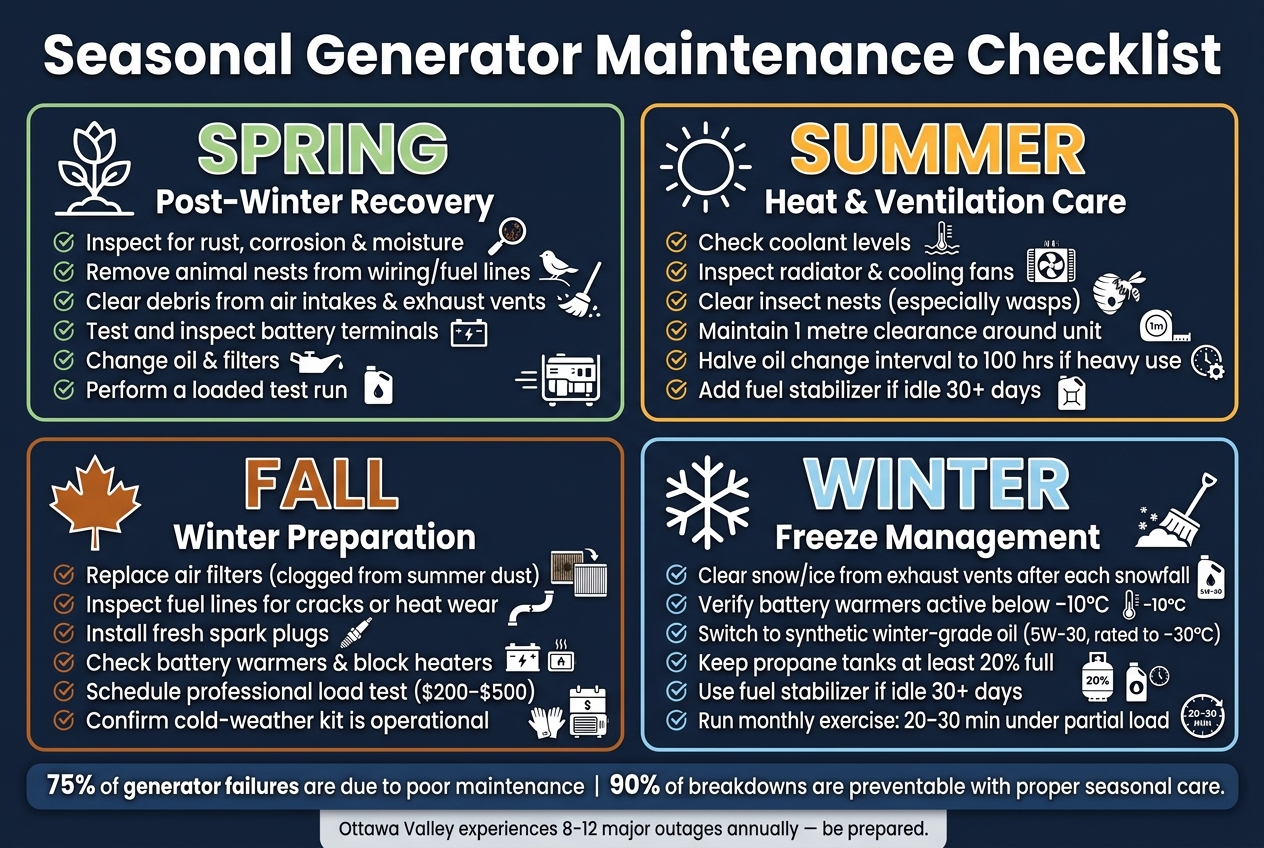
Seasonal Generator Maintenance Checklist: Spring, Summer, Fall & Winter
Keeping your generator in top shape throughout the year requires more than routine maintenance – it means tailoring your efforts to the demands of each season. In Canada, where the weather can swing dramatically, what works in July won’t cut it in January. Neglecting seasonal preparations can leave your generator unprepared when you need it most.
Spring is the time to address any damage caused by winter. Start by checking for rust, corrosion, moisture buildup, or animal nests that might have affected wiring, battery terminals, or fuel lines. Clear away debris from air intakes and exhaust vents to ensure proper airflow.
Winter can take a toll on batteries, so inspect them for corrosion and test their efficiency. Replace oil and filters to remove any moisture-related degradation. Wrap up with a loaded test run to confirm your generator is ready for spring storms.
Summer heat brings its own set of challenges. High temperatures can impact oil viscosity, increase the risk of overheating, and speed up fuel degradation. Check coolant levels and inspect the radiator and cooling fans for damage or obstructions. If your generator sees heavy use during summer storms, consider halving your oil change interval from 200 hours to 100 hours.
Ventilation is especially crucial in the summer. Look for insect nests, particularly from wasps, as they often build in warm, enclosed spaces. Maintain at least 1 metre of clearance around the generator. For gasoline-powered units, use a fuel stabilizer to prevent degradation if the fuel sits idle for 30 days or more.
As the weather cools, it’s time to shift your focus to preparing for winter.
Fall is your last chance to get your generator winter-ready. Replace air filters clogged with summer dust and inspect fuel lines for cracks or wear from the heat. Install fresh spark plugs and ensure your cold-weather kit – like battery warmers and block heaters – is in good working order. This is also a good time to schedule a professional load test to confirm your generator can handle a full load before winter sets in.
"Regular generator maintenance keeps your unit ready to perform at a moment’s notice and prevents common winter issues such as fuel gelling or line blockages." – Lloyd’s
For professional load testing or complete generator maintenance in the Ottawa Valley, Draper Electric is a trusted resource.
Winter requires extra attention to deal with freezing temperatures. After every major snowfall, clear snow and ice from exhaust vents to prevent carbon monoxide buildup. Make sure battery warmers and block heaters are operational before temperatures drop below −10°C. Switch to full synthetic winter-grade oil (5W-30) to ensure reliable engine starts in sub-zero conditions.
For propane systems, keep tanks at least 20% full to avoid pressure problems in extreme cold. Use a fuel stabilizer for gasoline if the generator will be idle for more than 30 days. Monthly exercise runs – running the generator for 20 to 30 minutes under a partial load – help keep seals lubricated and confirm the battery is charging properly.
| Season | Primary Focus | Key Tasks |
|---|---|---|
| Spring | Post-winter recovery | Rust/corrosion inspection, battery testing, nest/debris removal, oil change |
| Summer | Heat & ventilation care | Coolant check, radiator/fan inspection, insect nest clearance, fuel stabilizer |
| Fall | Winter preparation | Fuel line inspection, air filter and spark plug replacement, cold-weather kit check, load test |
| Winter | Freeze management | Snow/ice removal from vents, battery warmer/block heater check, winter-grade oil, fuel additives |
Standby generators, transfer switches, and GenerLink systems require specific seasonal maintenance to ensure they perform when you need them most. These tasks complement the general upkeep routines covered earlier.
Standby generators, unlike portable ones, are permanently installed and kick in automatically during outages. This convenience comes with the need for consistent care, especially for their enclosures and control panels. Each spring, check the enclosure for signs of moisture or pest damage. Seasonally, test the control panel to ensure it properly triggers the Automatic Transfer Switch (ATS). Don’t overlook the battery – what works in September might fail during a harsh winter.
Plan for servicing your standby generator every six months or after 100–200 operating hours. For residential units, annual maintenance costs range from $200 to $500. This is a small price compared to replacing a control board ($500–$2,500) or dealing with emergency call-out fees ($250–$500 or more).
The transfer switch plays a crucial role in connecting your generator to your home or business’s electrical panel.
"The transfer switch is the bridge between your generator and your home’s electrical panel. It safely shifts your power source during an outage. If this component fails, your generator might run perfectly but fail to power your home." – Generator Technologies, Inc.
If a transfer switch malfunctions, even a perfectly running generator won’t supply power. For both GenerLink systems and standard ATS units, inspect electrical cables for cracks or corrosion, clean terminals with a wire brush, and apply dielectric grease to prevent future issues. Test the switch by simulating an outage each season to ensure it engages and disengages as it should. Additionally, have a licensed electrician check and tighten terminal connections annually, as they can loosen over time with regular use.
In Ontario, any electrical work on transfer switches must be performed by an ESA-licensed electrician. Draper Electric offers installation and servicing for both GenerLink systems and transfer switches for residential and commercial properties throughout the Ottawa Valley.
Standby systems for homes and businesses have different priorities and maintenance needs. For homeowners, the focus is on powering essential systems like heating, sump pumps, and appliances, especially during Ottawa’s winter outages. With 8 to 12 significant power outages annually in the region, a semi-annual maintenance schedule – spring and fall – usually suffices.
Commercial generators, however, often require more frequent attention. Businesses that rely on uninterrupted power for IT systems, refrigerated goods, or continuous operations might need monthly inspections and load bank testing. Urban commercial units are particularly at risk for rodent damage, as small animals can nest in enclosures, leading to wiring problems or ventilation blockages.
| Feature | Residential Care | Commercial Care |
|---|---|---|
| Primary Goal | Home comfort, heating, and safety | Business continuity and IT/equipment protection |
| Maintenance Frequency | Twice yearly (spring/fall) | Monthly inspections; shorter intervals for heavy use |
| Key Risks | Battery failure in cold; stale fuel | Rodent damage to wiring; corrosion in industrial settings |
| Regulatory Needs | ESA permits for installation and modifications | Strict compliance with provincial safety codes |
Whether you’re safeguarding a family home or a business, regular and documented maintenance keeps your standby system dependable. Plus, it’s often a requirement to maintain your manufacturer’s warranty.
Generators often fail when they’re needed most, especially if they’re not maintained regularly. Did you know that 75% of generator failures are linked to poor upkeep? The good news: over 90% of these issues can be avoided with proper professional servicing. In the Ottawa Valley, where residents endure 8–12 major power outages annually – thanks to ice storms and summer thunderstorms – routine maintenance isn’t just a good idea; it’s a must.
The best approach? Schedule professional servicing twice a year. Aim for early fall, ahead of the winter storm season, and again in spring, after the strain of freezing temperatures. Expect to spend about $200–$500 annually on these services. It’s a small price compared to emergency repair bills, which can soar to $2,500 or more during a January outage.
The bottom line: consistent, expert care keeps your generator ready when you need it most.
While some maintenance tasks are DIY-friendly, others should be left to licensed professionals. Homeowners can handle basics like checking oil levels, clearing snow from vents, and running monthly tests. But when it comes to more complex tasks – like dealing with electrical connections, fuel systems, or transfer switches – it’s not just safer but often required to hire a professional. In Ontario, these jobs must be performed by an ESA-licensed electrician to ensure safety and maintain your warranty.
For expert help with essential services like electrical checks or fuel system inspections, turn to ESA-licensed professionals such as Draper Electric. They specialize in generator installations, seasonal maintenance, and troubleshooting for standby systems, transfer switches, and GenerLink setups in the Ottawa Valley. Whether it’s preparing for winter or catching up on overdue maintenance, scheduling professional care is a smart move.
Selecting the right generator size depends on whether you’re looking to power just the essentials or your entire home. For medium-sized homes (up to 2,500 sq. ft.), a 14 kW generator is often sufficient. Larger homes or those needing full-house power might require a 22 kW unit. If your needs are smaller – like keeping the fridge and lights running – a generator in the 5,000–7,000-watt range could do the job.
Draper Electric offers site assessments to help you find the perfect generator size for your specific requirements.
A failing battery often shows clear warning signs, such as corrosion on the terminals, loose connections, or a voltage reading below 12.4V. If your vehicle struggles to start, experiences "hard starting", or fails routine tests, it might be time to replace the battery – especially if it’s nearing the typical lifespan of 3 to 5 years.
Fuel problems can also cause trouble. Be on the lookout for poor engine performance, clogged systems, or fuel degradation. Keep in mind that gasoline can start to go stale in as little as 30 days.
If you notice any of these issues, it’s a good idea to reach out to Draper Electric for a professional inspection and maintenance.
You can take care of simple tasks like checking oil levels or removing debris. However, for more complex work – like diagnostics, annual inspections, or load testing – it’s best to call an ESA-licensed electrician from Draper Electric. These professionals are equipped with the right tools and knowledge to handle repairs safely while ensuring compliance with provincial safety codes. If you’re ever uncertain about a procedure or dealing with recurring problems, reach out to Draper Electric to keep your generator running smoothly and safely.