Electrical Products & Services
Why home battery backups fail: incorrect sizing, incompatible components, wiring errors, poor placement, and lack of maintenance.
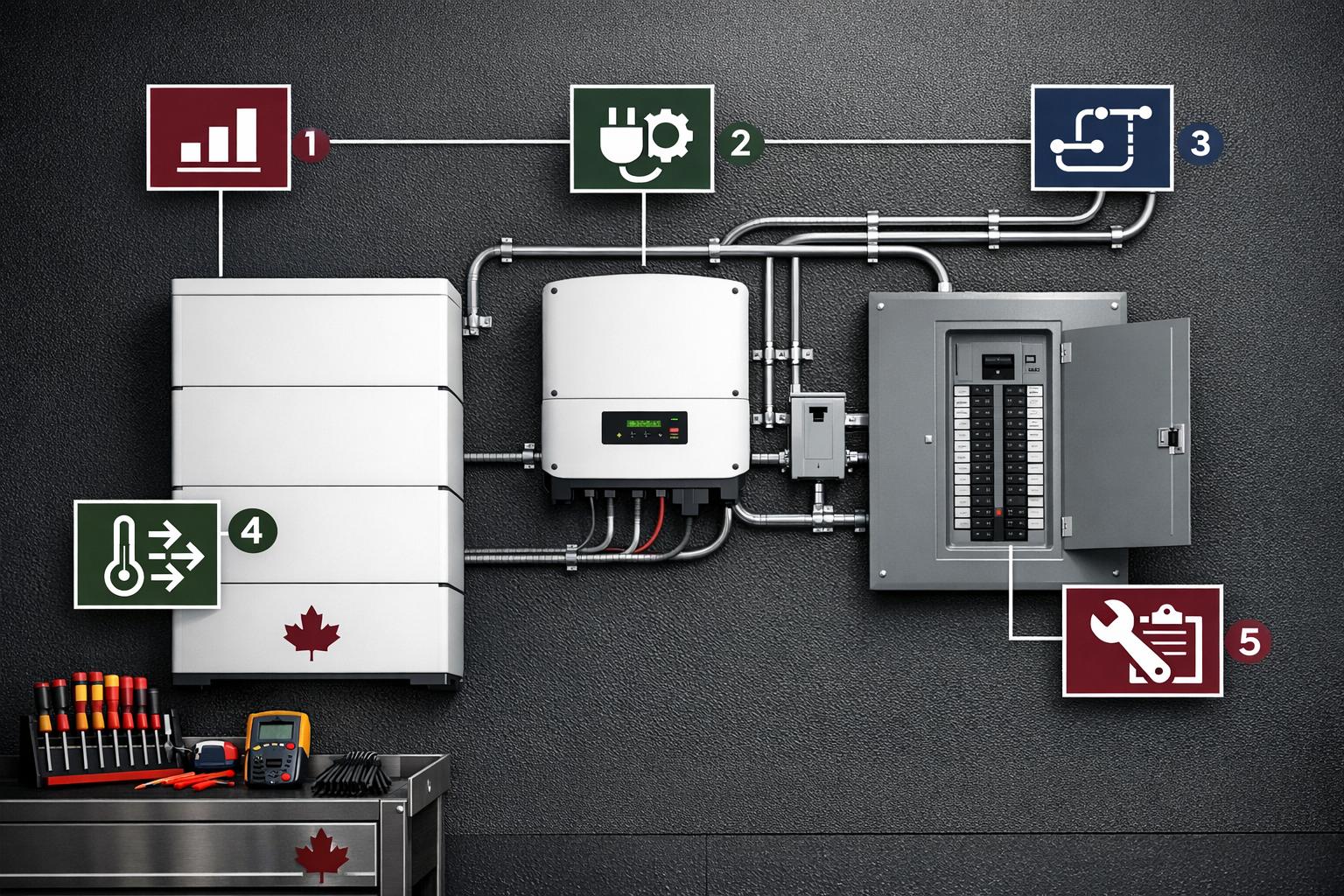
Power outages in the Ottawa Valley are frequent, with over 270 reported in 2025 alone. Battery backup systems can provide reliable power during these outages, but improper installation can lead to failures, safety risks, and non-compliance with Ontario’s strict electrical standards. Here are the five most common issues to watch for:
Hiring a licensed electrician ensures compliance with Ontario’s electrical code, proper system performance, and peace of mind during outages.
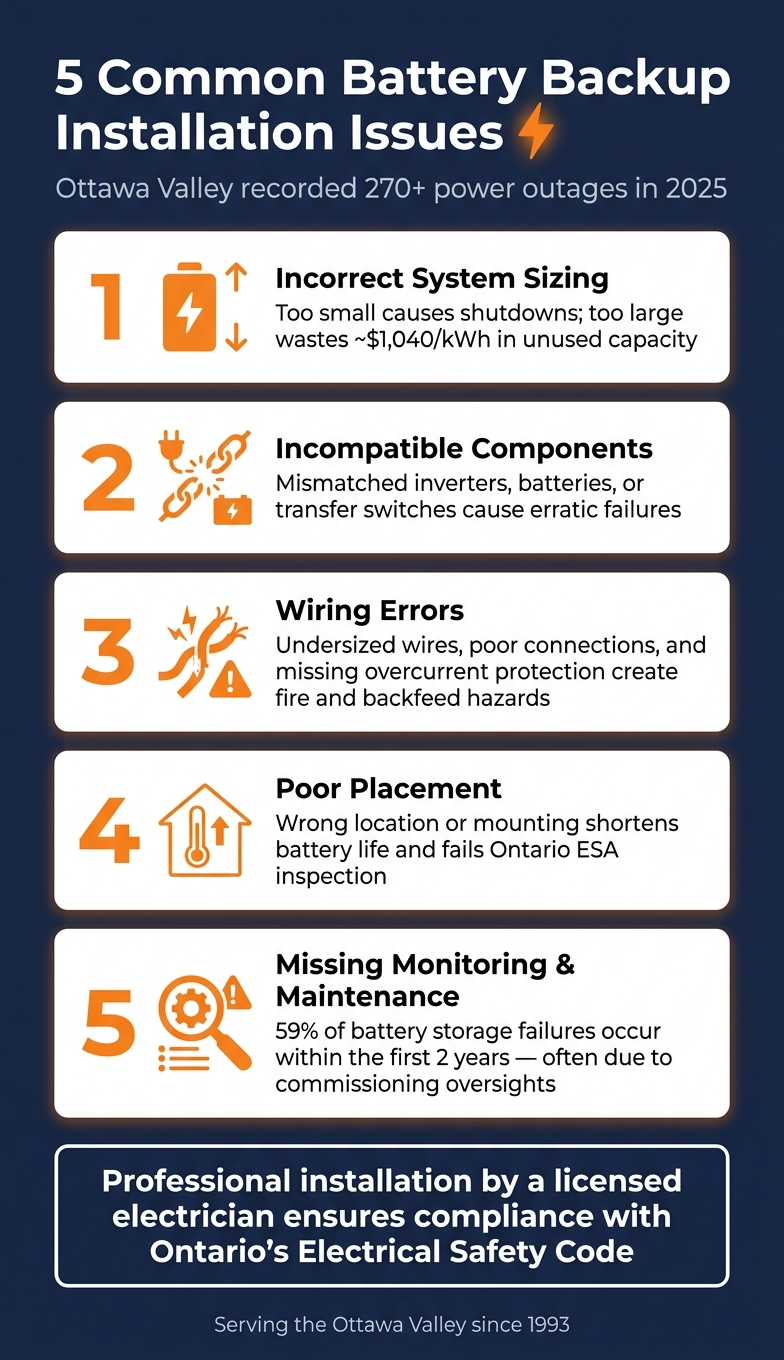
5 Common Battery Backup Installation Issues (Ottawa Valley Guide)
One of the biggest pitfalls in battery backup installations is getting the system size wrong. Whether it’s too small or too large, both scenarios can cause unnecessary headaches.
An undersized system is a disaster waiting to happen. Appliances like sump pumps, refrigerators, and furnace blowers can demand 3–7 times their running wattage when they start up. If your inverter or battery can’t handle that surge, the system will shut down, leaving you in the dark. On the flip side, an oversized system means you’re paying for capacity you might never use. Considering the installation cost sits at about $1,040 per kWh, that unused capacity can seriously strain your budget.
"The gap between a battery system that works and one that trips in the middle of an outage isn’t usually a product quality problem. It’s almost always a sizing problem." – IntegrateSun
The key to avoiding these issues is a proper load assessment. This means taking a hard look at what appliances you truly need during an outage. A good rule of thumb? If you can live without it for 24 hours, it doesn’t belong on your critical load panel. Focus on essentials like your fridge, lights, Wi-Fi, sump pump, and furnace fan, and skip high-energy items like electric dryers or EV chargers. This approach keeps costs down and maximizes runtime.
Once you’ve identified your critical loads, it’s time to crunch the numbers. Keep in mind that batteries have a depth of discharge (usually 80–95% for lithium systems), a round-trip efficiency of about 85%, and should include a 15–30% buffer for ageing and temperature effects. For instance, a battery rated at 13.5 kWh doesn’t deliver the full 13.5 kWh for backup – its usable capacity is lower. And don’t forget to consider future needs, like an EV charger or heat pump, to avoid expensive upgrades later on.
Here’s a quick look at typical setups:
| Backup Scope | Typical Storage | Estimated Installed Cost | Runtime |
|---|---|---|---|
| Partial (5–10 circuits) | 10–15 kWh | $12,000–$16,000 | 12–24+ hours |
| Whole-Home (small house) | 15–20 kWh | $22,000–$28,000 | 12–18 hours |
| Whole-Home (large house) | 20–30+ kWh | $28,000–$40,000+ | 18–36 hours |
Note: Costs are approximate U.S.-based figures converted for reference. Canadian pricing may differ.
Getting the sizing and load assessment right is the foundation for a smooth and effective installation. It ensures all components work together seamlessly and avoids costly mistakes down the road.
Once you’ve nailed down the right sizing and load assessment, the next step is ensuring all system components work together smoothly. Even the most accurately sized system can fail if its parts aren’t compatible. Batteries, inverters, and transfer switches all come with specific technical requirements, and mismatched components can lead to erratic behaviour or outright failure during a power outage.
Take the neutral-ground (N-G) bonding conflict, for instance. Every system needs exactly one N-G bond. If both your inverter and backup generator have internal bonds, it can create ground loop currents, which may cause nuisance GFCI tripping. To avoid this, check your inverter’s internal bond using a multimeter in continuity mode. A near-zero reading between the AC output neutral and the chassis confirms the bond is present.
Another critical factor is how well components communicate. The battery’s Battery Management System (BMS) must send real-time data – like cell voltages, temperature, and state of charge – to the inverter every second via CAN bus or RS485. Without the proper manufacturer-supplied cable, the inverter essentially operates without essential data.
"Without this [BMS] cable, the inverter manages the battery blind." – Eneronix
Compatibility issues often arise when mixing components from different manufacturers. For example, a hybrid inverter must be explicitly compatible with the battery brand you’re using. Similarly, if you’re setting up parallel inverters, they need to be identical models connected with the correct CAN/RS485 cables. As Tina Kass, a solar installer from Solarelios, explains:
"Never mix inverter models or use generic serial cables for the inverter parallel cable. That can damage communication interfaces or result in unsafe load sharing behaviour."
The safest bet? Stick with unified platforms – systems where the inverter, battery, and software are designed to work together seamlessly. When components are mismatched, they often function in isolation, leading to inefficient charge cycles, unstable performance under load, and unreliable backup operation. As NeoVolta points out, "Most battery systems don’t fail because of the battery. They fail because of how they’re installed." Proper integration is key to ensuring dependable performance when it matters most.
Proper wiring is just as critical as correctly sizing and integrating components when it comes to battery backup systems. Even the best-designed setup can become a fire hazard or fail to meet code requirements if the wiring isn’t done correctly. Wiring mistakes are not only common but also incredibly dangerous, often going unnoticed until a failure occurs. Let’s break down some key considerations to avoid these risks.
Wire gauge selection is one of the most frequent issues. Undersized wires lead to increased resistance, which can cause voltage drops and dangerous heat buildup. Both the Canadian Electrical Code (CEC) and the NEC recommend limiting voltage drop to no more than 3% for branch circuits. For example, a 30A, 240V inverter output typically requires 10 AWG copper wiring, while a 50A circuit needs 6 AWG copper. However, if the wire run exceeds 36 metres on a 30A circuit, you’ll need to use a thicker wire – one gauge larger – to stay within the 3% voltage drop guideline.
| Circuit Capacity | Wire (Copper) | Wire (Aluminium) | Breaker Size |
|---|---|---|---|
| 30A (240V) | 10 AWG THHN | 8 AWG THHN | 30A Double-pole |
| 50A (240V) | 6 AWG THHN | 4 AWG THHN | 50A Double-pole |
Another common problem is inadequate connections. Connections that are either hand-tightened or over-tightened can create high-resistance points, which may overheat and lead to system failure. Always adhere to the manufacturer’s torque specifications for terminals to ensure safe and secure connections.
Missing or improperly rated overcurrent protection is another serious hazard. Without the correct DC circuit breakers or fuses, faults can result in arc flashes or even catastrophic equipment failure. It’s also essential to follow the NEC 120% rule, which states that the combined amperage of your battery backup breaker and main breaker must not exceed 120% of the panel’s busbar rating. In Canada, the CEC specifies a similar limit of 125% for interconnected systems. Ignoring these rules can lead to code violations and inspection failures.
One often-overlooked danger is backfeeding, which occurs when improper transfer switch wiring allows electricity from your battery system to flow back onto the utility grid during an outage. This poses a serious risk to utility workers. Trevor Tremblay, Technical Advisor at the Electrical Safety Authority, highlights this concern:
"With the power going out and people having these systems installed in their homes… they can be inadvertently sending it back to the grid… it could actually put workers in jeopardy by back feeding the grid."
To ensure safety and compliance, always have a licensed electrician verify that the wiring meets OESC and CEC standards before activating your system.
Where you place a battery backup system is just as important as how it’s wired. Installing a unit in an unheated garage or a damp utility area can shorten the battery’s lifespan and increase safety risks – especially in Canada, where the weather can swing drastically between seasons. Controlling temperature is key to getting the most out of your battery.
Temperature is the number one factor affecting battery life. Most lithium-ion home batteries are designed to last 10 to 15 years, but that’s only true if they’re kept within their recommended temperature range. Cold winters, in particular, can be brutal on standard lithium-ion batteries. If you’re thinking about installing a battery in an outdoor or unheated space, make sure it has integrated self-heating capabilities. Without this feature, you could be shaving years off its lifespan every winter. Lithium Iron Phosphate (LiFePO4) batteries are often the go-to choice for Canadian homes because they perform well in extreme temperatures. Pairing effective temperature management with proper installation and mounting practices is essential.
The location of your system is also subject to specific code requirements. For example, in Ontario, the electrical code mandates at least 1 metre of clearance around equipment installed in garages. Indoor setups must be in a fire-rated utility room with finished drywall, an interconnected fire alarm, and a self-closing fire-rated door. Outdoor installations need a purpose-built enclosure and are typically only suited for batteries with self-heating capabilities. These measures are necessary to pass an ESA inspection. Beyond the location itself, proper mounting is another way to ensure the system lasts longer.
"Battery performance and longevity depend on temperature management and proper installation, which makes airflow clearance and correct mounting critical for Canadian conditions." – Tina Kass, SolarElios
The type of mounting you choose also matters. Rack-mounted systems must be anchored to concrete, while wall-mounted units require proper stud support and rated hardware. In tight spaces like condo mechanical rooms, don’t overlook ventilation – a small fan can make a big difference in keeping temperatures stable.
| Installation Location | Key Requirements (Ontario Electrical Code) |
|---|---|
| Garage (Attached or Detached) | Minimum 1 metre clearance around all equipment |
| Indoor Utility Room | Fire-rated room, finished drywall, interconnected fire alarm, self-closing fire-rated door |
| Outdoors | Purpose-built enclosure; battery must have integrated self-heating capabilities |
One detail that’s easy to miss: make sure there’s enough room for maintenance. Squeezing a battery system into a tight corner might seem fine at first, but it’ll quickly become a headache when you need to swap a module, inspect connectors, or check breakers. Always leave enough space for service access.
Getting the physical installation right is only half the job. What happens after the wiring is just as important. Post-wiring testing, when combined with proper sizing, integration, and wiring practices, ensures the system works as intended.
Commissioning is a crucial step. It involves testing every terminal with calibrated tools, simulating power outages by flipping the main breaker, and verifying the battery’s load capacity. This process often uncovers overlooked details, like critical appliances that weren’t included in the initial design. Skipping this step doesn’t eliminate problems – it just delays them.
"Most BESS failures are install and commissioning failures, not equipment failures." – Kamil Talar, MSc., BESS Specialist
A well-configured system should do more than just work – it should actively monitor itself. Alerts for issues like temperature spikes, low battery levels, or charging faults are essential. They help catch problems like imbalanced cell voltages or temperatures that could lead to thermal runaway. Research indicates that nearly 59% of utility-scale battery storage failures happen within the first two years, and many of these could be traced back to commissioning or monitoring oversights.
The handover process is just as important as the installation. Homeowners need a clear walkthrough of the system, covering how to operate the control panel, interpret fault codes, use manual controls, and track the battery’s State of Health (SOH). Since battery capacity naturally declines over time, understanding SOH is critical – especially during extended outages when every bit of capacity counts. This step ensures the system is not just installed but ready for reliable, long-term use.
Once commissioning is complete, a maintenance plan becomes the backbone of system reliability. Regular upkeep, including professional inspections, keeps everything running smoothly. In the Ottawa Valley, annual maintenance services typically cost between $200 and $350 and include essential tasks like battery load testing, terminal cleaning, and firmware updates. A good maintenance plan might look like this:
| Maintenance Task | Frequency | What It Covers |
|---|---|---|
| Self-exercise cycle | Weekly | Automatic start/stop, battery charge check |
| Battery load testing & cleaning | Monthly/Annual | Voltage checks, ensuring connection integrity |
| Professional inspection | Annual | Full system check, firmware updates, load testing |
| Commissioning baseline review | At installation | Establishes SOH for future warranty claims |
Companies like Draper Electric follow these rigorous standards for commissioning and maintenance, ensuring systems perform reliably when it matters most.
For the first 90 days after installation, daily monitoring of alarms and temperature alerts is crucial. This helps catch any lingering installation issues before they become major problems.
Installing a battery backup system is a complex process. Mistakes like incorrect sizing, incompatible components, wiring errors, poor placement, or skipping maintenance planning can undermine the system’s performance and compromise an investment that can cost up to $25,000 CAD. In areas like the Ottawa Valley, where severe storms frequently lead to extended power outages, a system failure during a critical moment can have serious consequences.
Fortunately, these issues are entirely avoidable with professional installation. Licensed electricians handle everything from precise load calculations and securing ESA permits to selecting compatible components and performing commissioning tests to identify potential problems before they escalate. As Randy Draper, Master Electrician at Draper Electric, explains:
"Our reputation for diligence, thoroughness and quality is well known throughout the industry."
When the stakes are high, accountability matters. A system that’s improperly sized or wired not only fails to perform but also creates safety risks, voids warranties, and could leave you powerless during an emergency. Addressing these challenges from the start ensures the system performs reliably when you need it most. Adhering to Ontario’s strict installation standards and relying on licensed professionals is the best way to guarantee your system is ready for action.
Since 1993, Draper Electric has been a trusted name in the Ottawa Valley for battery backup installations, standby generators, transfer switches, and panel upgrades. Whether you’re planning a new system or troubleshooting an existing one, working with a skilled local team ensures you avoid the pitfalls outlined here and enjoy peace of mind during power outages.
To choose circuits for your critical loads panel, it’s important to align your essential needs with the capacity of your battery system. Begin with a professional load analysis to pinpoint appliances with high energy demands. Focus first on health and safety necessities, such as medical devices, refrigerators, and sump pumps. After that, consider comfort essentials like lighting and internet routers. To make the most of your battery’s runtime, skip non-essential items like electric dryers.
Yes, in Ontario, you are required to notify the Electrical Safety Authority (ESA) for any battery backup installation. This step is crucial to ensure your system meets the Ontario Electrical Safety Code.
For installations that are larger or involve more complex systems, you may also need to go through a formal plan review process.
If you’re looking for help navigating these requirements, Draper Electric provides professional installation and maintenance services to ensure your setup complies with all regulations.
Yes, a battery backup can power your entire home during an outage – as long as it’s properly sized and includes an automatic transfer switch. How long it lasts depends on the system’s storage capacity. For instance, a 13.5 kWh battery might provide power for 4–8 hours if running the whole house or 12–24 hours when limited to essential loads. Adding solar panels can stretch this runtime by recharging the battery during the day. Draper Electric can help you figure out the best setup for your needs.